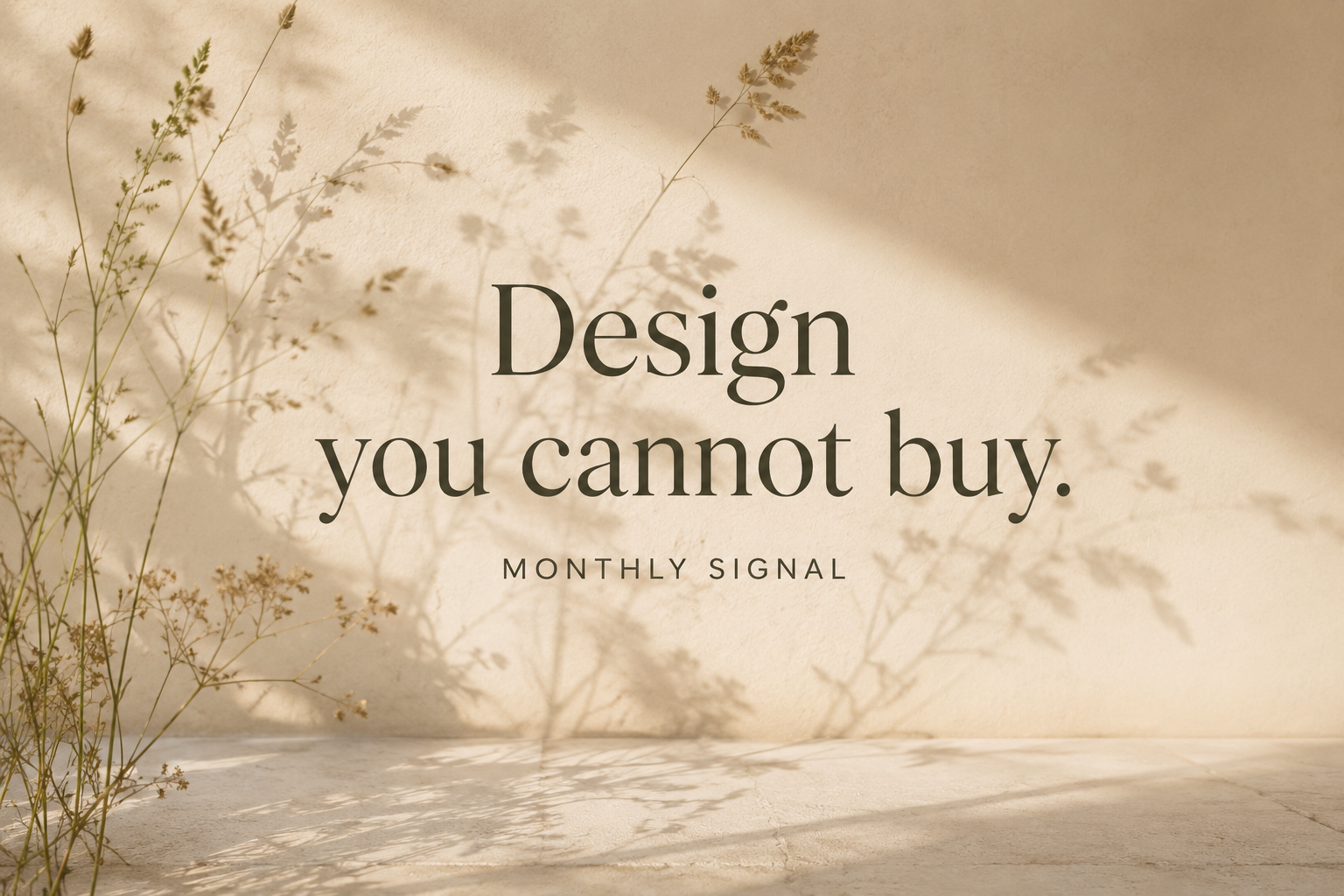
When exactly did we come to believe that beauty at home has to be purchased in a design shop?
As children, we knew it instinctively. We stopped for things for no practical reason whatsoever. Someone showed us how intensely a tomato leaf smells when you rub it between your fingers. How perfectly smooth and glossy a freshly shelled chestnut is. How geometrically precise the shape of a spent thistle head can be.
We did not do this because it mattered for our performance or survival. We did it simply because it was beautiful.
Design does not begin in a studio at a drawing board or in front of a computer screen. It begins much earlier — in the moment when we pause for a while and start to look more carefully.
Meadow Objects as Interior Architecture
When I look at wild nature as a designer, I do not only see flora. I see structures. I see lines, shadows and spatial qualities that function in an interior as distinctive micro-architectures.
There is no need for floral showmanship, enormous colourful bouquets or expensive exotic flowers from the other side of the world. The magic lies in absolute simplicity and in how an ordinary thing can change the scale and atmosphere of an entire room.
-
Wild caraway and grasses
When you place one tall, gently dried stem of wild caraway into a narrow minimalist vase, it becomes a graphic line. Its delicate habit defines the space around it, bringing lightness and airiness into the room.
-
Thistles and spent poppy heads
These are not weeds or garden waste. They are organic sculptures. They carry raw texture, permanence and an earthy colouring that creates a perfect visual contrast on a smooth sideboard or concrete-plastered wall.
-
Branches after a storm
Wood beaten by a flowing river or broken by a strong wind carries within it the dynamic of movement. A single dramatically shaped branch can stage a shadow play on a wall that no printed image could ever replace.
These objects have no ambition to shout. And yet they change the dynamic of an interior. They bring calm into it, because within them is encoded time and the natural cycle of life.
The Ethics of Gathering: Taking Only What Has Already Been Released
This article is not intended as a guide to setting off into the forest on the next walk with scissors in hand and coming home with half a meadow.
Nature is not a decorative storage room for our living spaces. The true art of attentiveness lies in not taking more than nature painlessly offers us of its own accord.
The most beautiful objects will find you by chance. A dried stem of wild carrot that has long since completed its life cycle and returned its seeds to the earth. A branch broken by strong wind, already lying in the grass. A spent poppy head in an autumn garden.
When you do take something from outside, let it be what nature itself has let go. Something that no longer lives, yet in its dry, archetypal form carries the pure essence of shape.
Sometimes it is precisely the most fragile thing that lasts longest at home. And what is most precious — that feeling of calm and a clear head — is something we carry away within ourselves regardless.
Conclusion: A Lesson from Silence
Decorating a home with natural solitaires without unnecessary pretension means embracing the aesthetics of sustainability and quiet. It shows our ability to see value in transience and in details that most people pass by without noticing.
Next time you walk back from a trip, or simply pass the overgrown field at the edge of your neighbourhood, do not rush.
Look more carefully. Perhaps the best piece of design you will ever see is waiting there for you.
And what about you?
Do you have a favourite piece of design at home that you did not buy, but that simply found you on the way?
When did you last stop outdoors — not because you had to, but because something was simply... beautiful?
Write to us via the Grain of Design contact form.