Coffee stops: design between city and world's edge
When the difference between cultures becomes an adventure
1. When a craving for coffee turns into a cultural manifesto
The road from Málaga to Gibraltar.
At first glance, an innocent move.
Sun, road, open landscape. And somewhere in between — a craving for coffee.
I stop at the first "tavern".
The doors creak as if warning me. Inside:
bearded men with hats, a dirty bar, a fan that remembers Franco,
overhead jamón that long ago decided to be something else.
Behind the counter, a man without eyebrows and without interest.
If it weren't realism, it would be a western.
I leave.
Not offended. Just… aware.
I arrive at Gibraltar with a monkey on the hood and a cup in hand.
Victory of aesthetics over entropy? Not at all.
Just another proof that borders aren't lines — they're layers.
2. City as a layered sentence
Designers often dream of the new.
Of white surfaces, clean lines, tabula rasa.
But a city isn't a blank slate.
It's a book.
And every street, every arcade, every weathered entrance is a word.
A word that has memory. A word that has influence.
When we demolish houses just because they're not current,
it's like tearing pages from a poem,
just because it's not in the font that's trending now.
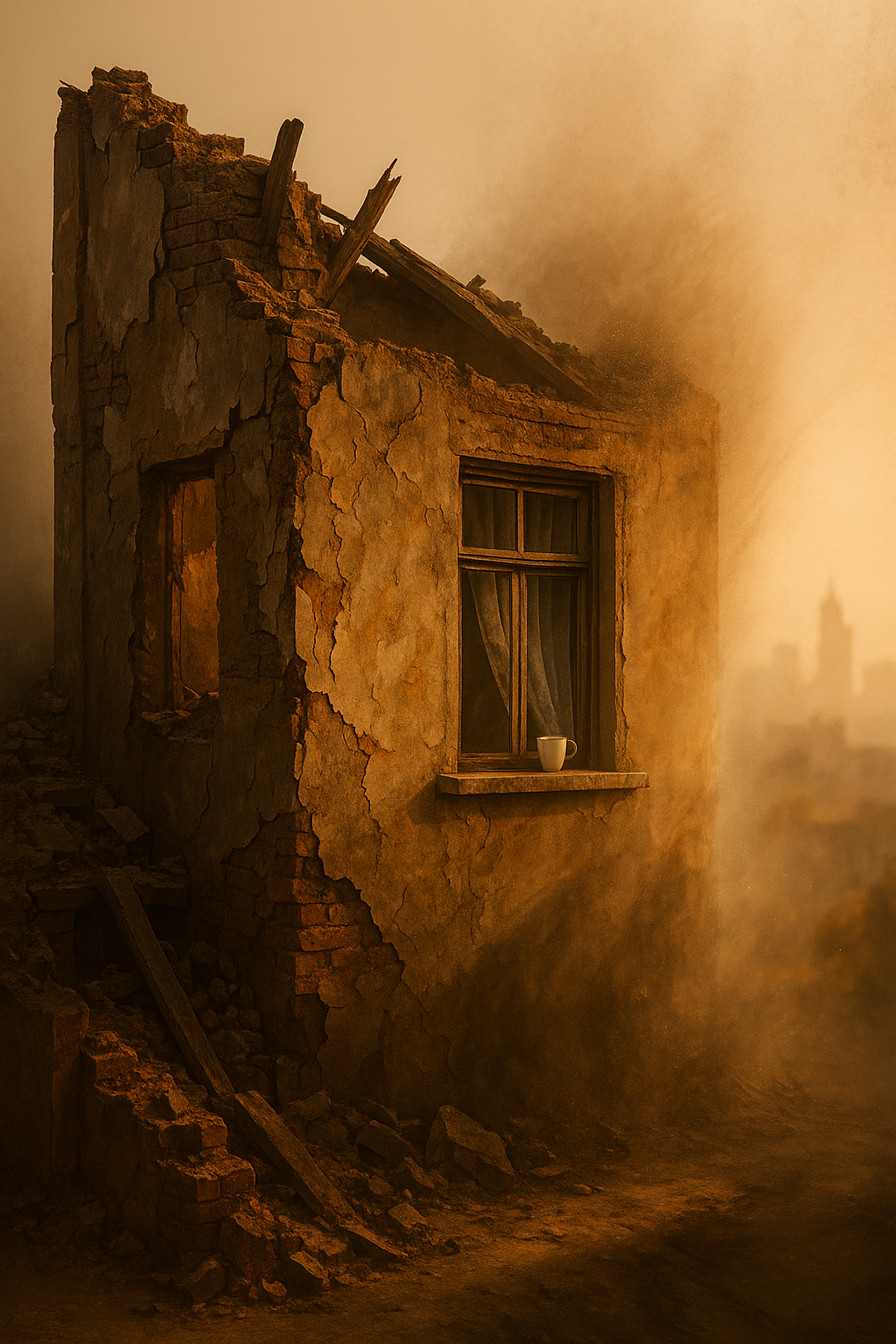
3. Lighthouses that disappear
Some houses are like lighthouses.
They don't stand on the map of beauty, but on the map of orientation.
They don't shine with LED strips, but with memories.
And when they disappear… silence remains.
Something breaks.
And maybe we don't even know what, but it's not the same anymore.
Some places hold the landscape together.
4. Difference in taste? Or chasm between worlds?
We believe that design connects.
But reality often shows something different.
In cities where people go to exhibitions and theaters,
design is a language.
Elsewhere, it's an eccentricity.
Something suspicious. Elitist.
Even dangerous.
As if paint on a wall or a sculpture on a corner threatened "normalcy".
5. What to do about it?
We don't need to demolish more.
We need to read more.
Let the houses stand.
Let's ask them what they want to say.
Whether they smell of lost plaster or brew the best coffee in the village,
they are layers that shape the landscape and us.