Cooking isn't just about recipes. It's a way of thinking.
Just like design.
Design isn't only about the chairs we sit in or the lamps that light our work.
It's the way we put together ingredients, colours and textures — and that applies to the plate as well.
Just as a good architect thinks through the structure of a building first, a good cook (or an enthusiastic designer in the kitchen) thinks about the composition of flavours.
For me, a cookbook isn't a survival instruction manual.
It's a visual and intellectual manifesto.
It's about an approach to time, the aesthetics of the table, and the joy of work done with precision.
This selection brings you three titles that teach me to see cooking as a creative process — where simplicity doesn't mean boredom, and where even an ordinary dinner can have a clear concept.
Let's take a closer look at each of them.
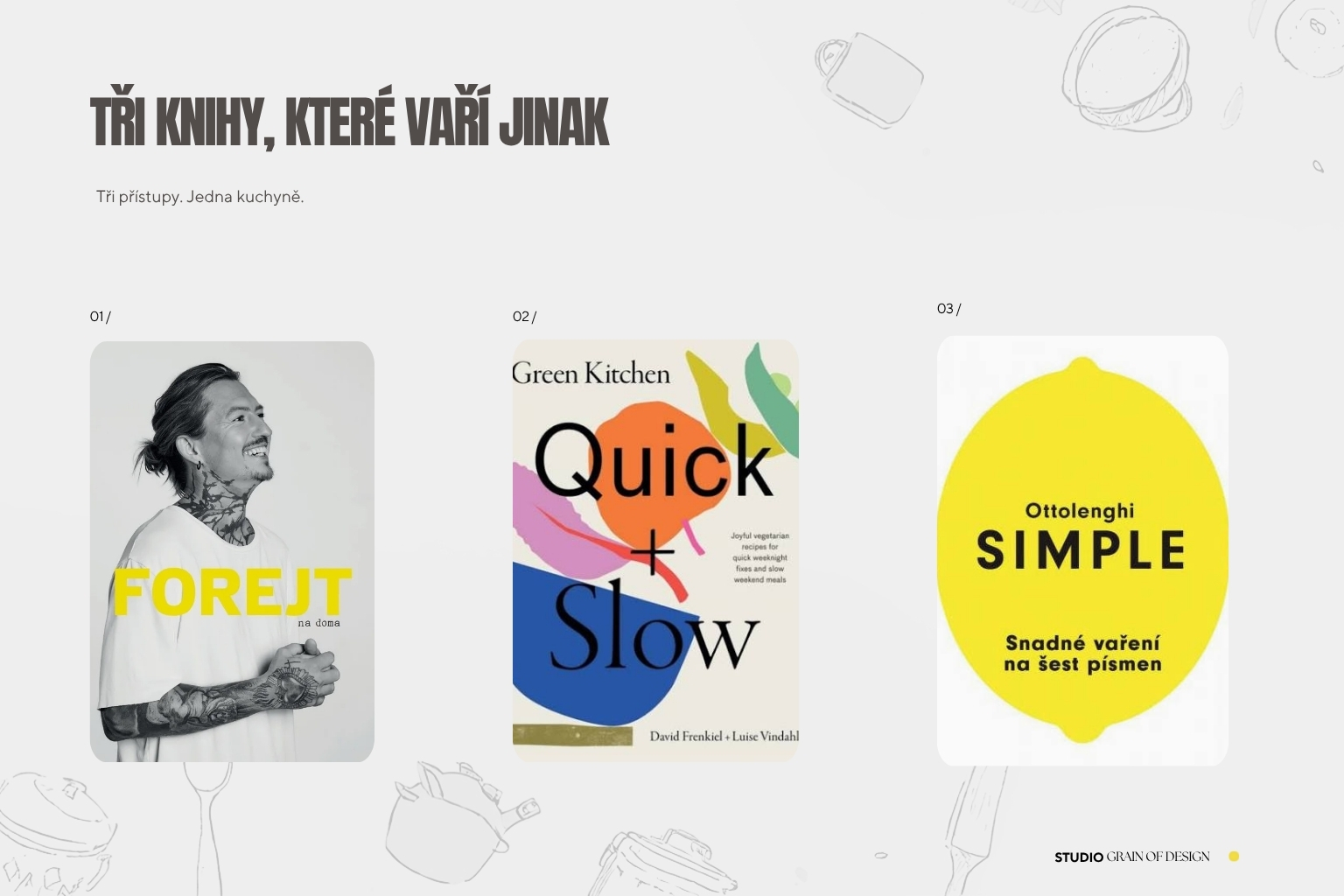
01 / Forejt na doma
Punk aesthetics with respect for the craft.
They say that truly learning to cook takes a lifetime and requires thousands of burnt attempts.
Přemek Forejt dismantles that idea with ease.
His debut cookbook is exactly like him:
visually bold, a little punk, but built on solid foundations of honest craftsmanship.
As head chef at Olomouc's Entrée — a place where the interior and the food form a single whole — he shows how to bring together seemingly incompatible worlds.
It's a lesson in deconstructing the classics.
How to turn an ordinary ingredient into an extraordinary visual and flavour experience, without losing the joy of the process.
What I love about the book from a design perspective:
Exceptional graphic design that isn't afraid to go against the grain.
The black-and-white dynamics of the photography and bold yellow typography elevate the book from cookbook to object.
And the enclosed tattoo sheet?
A detail that confirms that design isn't about perfection.
It's about distinctiveness.
02 / Green Kitchen: Quick + Slow
The rhythm of modern life in one kitchen.
If Forejt is design punk, then the creative duo David Frenkiel and Luise Vindahl is pure Scandinavian minimalism — with a deep sense of colour, light and texture.
Their book Quick + Slow is a precise study of how we work with time in the kitchen (and in life).
As designers, we deal with the ergonomics of space.
This book deals with the ergonomics of time.
The recipes are split into two approaches that mirror our everyday reality:
QUICK
Functional, efficient solutions for hectic days.
Speed without compromising aesthetics.
SLOW
Lazy weekend rituals.
Cooking as a process that has its own pace — and its own meaning.
What I love about the book from a design perspective:
The visual side of the book is a fascinating play of natural light and the colours of ingredients.
Every dish looks like a composition you could easily hang on a wall.
It's proof that even plant-based cuisine can have striking visual depth and the atmosphere of a contemporary studio.
And at the same time something that disrupts the calm of my otherwise restrained selection —
an organic restlessness that is exactly where it should be.
03 / Ottolenghi: SIMPLE
A manifesto for the functional kitchen.
Yotam Ottolenghi is to gastronomy what Bauhaus is to architecture.
He brought a new language — complex, yet built on incredibly clean foundations.
The book SIMPLE is a fascinating study of how many different ways there are to define "easy".
It isn't just a cookbook.
It's a system.
Ottolenghi understands that each of us has a different capacity, a different pace, and different needs.
That's why he created the S–I–M–P–L–E key, which works as navigation through modern chaos:
S — Short on time
Ultra-fast recipes
I — Ingredients 10 or less
Minimal ingredients
M — Make ahead
Prepare in advance
P — Pantry
Cooking from your stores
L — Lazy
Dishes that "make themselves"
E — Easier than you think
Efficient tricks
What I love about the book from a design perspective:
The visual identity of this book is iconic.
A yellow lemon on a white background is the symbol of a relaxed yet precise style.
Ottolenghi proves that "easy" doesn't have to mean "banal".
It's about the ability to choose the right approach at the right moment.
Final Thought
Whether you choose Forejt's punk, the Scandinavian rhythm of Green Kitchen or Ottolenghi's systematic clarity, one thing stays the same:
The kitchen is a space for experimentation.
Just as design begins with an idea, good food begins with the courage to bring those ideas to life.