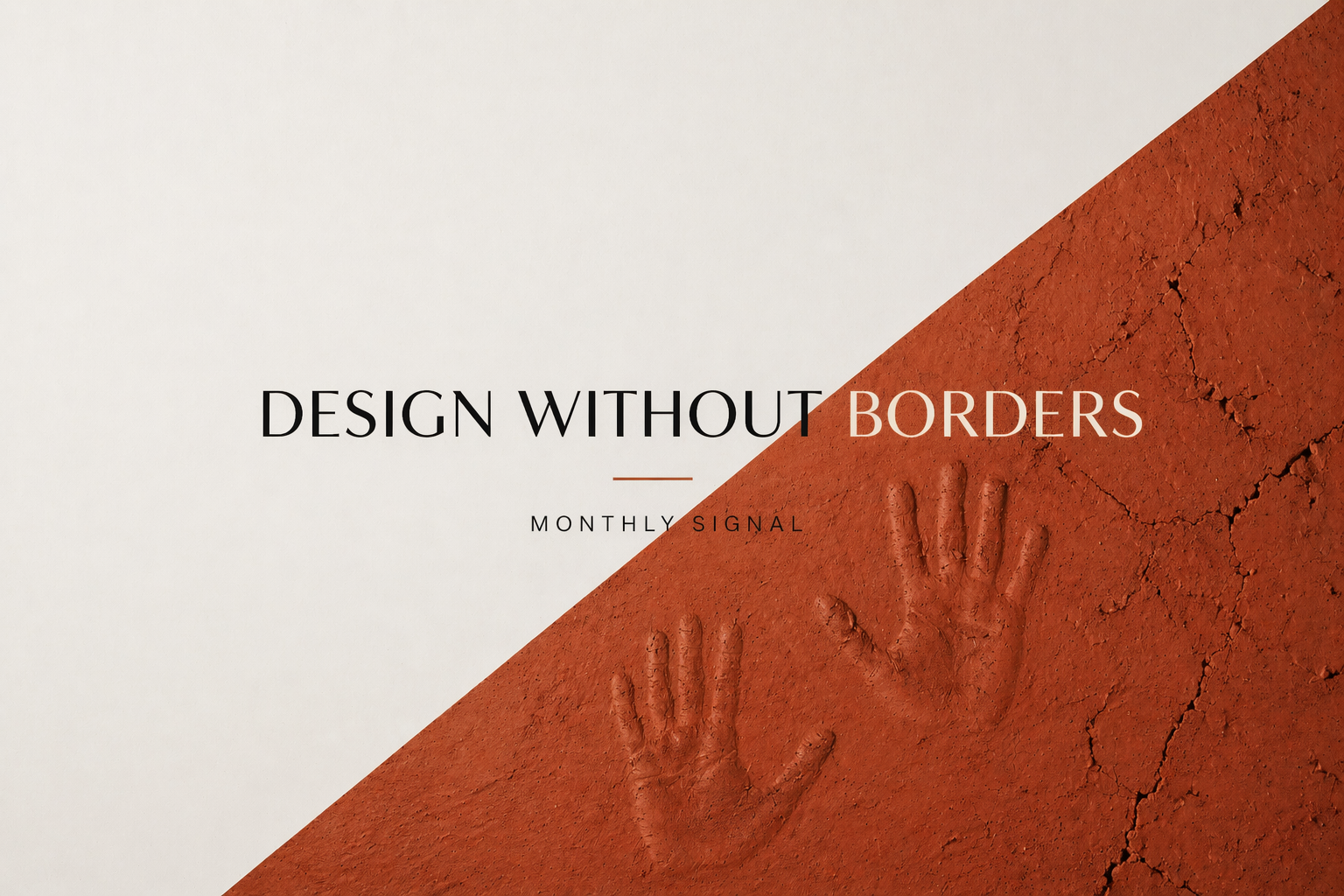
The End of the "Good Taste" Dictatorship
For years we were taught that "good design" looks like a sterile laboratory in Copenhagen or a glass skyscraper in New York. We learned to perceive minimalism as the pinnacle of civilisation and everything else — colours, textures, clay and ornaments — to push into the box labelled "exotic", "souvenir" or "the past".
But the map of design is quietly being rewritten. While the Western world struggles with an identity crisis and saturation, in centres like Lagos, Nairobi or Mexico City a new aesthetic is emerging — one that needs no permission from European galleries. This shift is called the decolonisation of design.
It is not just about swapping furniture. It is a radical shift in perspective, where new rules apply:
- Clay is not "low-cost" — it is a technologically advanced material of the future that breathes with the earth.
- Textiles are not decoration — they are an archive of stories, genealogies and codes we carry on our bodies.
- Colour is not a mistake — it is energy and a manifesto of courage in a grey world.
Welcome to the era of Afrofuturism and the return to craft that lacks nothing in high-tech ambition. A world where the aesthetic centre is no longer only Milan. And where this very change may be the key to a more sustainable and colourful future for all of us.
The Return to Craft: More Than Just a Souvenir
For too long we perceived the craft production of cultures with unbroken traditions through the distorting lens of colonial tourism — as decoration without deeper meaning. A hand-woven basket or carved mask was a "souvenir", a cheap trinket meant to remind you of a holiday. The decolonisation of design reverses this narrative. Craft is not a relic of the past, but a living organism and one of the answers to the crisis of mass production.
Craft as High Technology
We must stop perceiving craft as something "primitive". When a weaver in a Malian village creates Bogolanfini cloth, he is not working with hands alone. He employs deep knowledge of chemistry, natural oxidation of pigments, the mathematical logic of patterns and local ecology.
What we long called "traditional production" is in fact a sophisticated system of knowledge. It just does not take place in a laboratory, but in landscape, community and the memory of material.
Clay is a perfect example. It is not a poor material, but an intelligent medium with enormous thermal inertia. The original techniques of working with unfired clay are being rediscovered today as cutting-edge sustainable urbanism that needs neither energy-intensive cement production nor permanent air conditioning.
Ethics Instead of Theft
The decolonisation of design is not only an aesthetic change. It is also an ethical one.
For too long, Western fashion houses and design studios "borrowed" patterns from indigenous communities without acknowledging their origin, meaning or authorship. Mexican embroideries, Berber symbols or African textiles became decorative scenery stripped of context.
Fortunately, a different model is emerging today. Instead of appropriation comes partnership. Instead of copying, long-term collaboration. Instead of exoticism, respect.
Modern studios no longer buy ready-made products at markets simply to sell them later with a huge mark-up in a gallery frame. They create collaborations in which craftspeople hold the status of co-designers. The result is not a copy of tradition, but a new design language that respects the sacred meaning of patterns while speaking to the contemporary user.
Textile as a Carrier of Code
Textile is not decoration. In many cultures, fabric is a second skin, an archive of identity and a communication channel.
Patterns are not random "ethnic" motifs. They are records of a community's state, political changes, protection, lineage and the memory of place. By layering these textiles in an interior, we are not just creating cosiness. We are building a space that has its own voice.
Recycling as Heritage, Not Trend
While the Western world has discovered the circular economy as a new buzzword, for many indigenous craft cultures it has been a natural way of being for centuries.
Repair is not failure. It is the continuation of a thing's life.
Traditions such as Japanese kintsugi or Indian kantha show that a crack is not a flaw, but part of the story. A repaired object can have greater value than a new one, because it carries within it the energy of human care, time and the decision not to give up.
Luxury is in understanding it.
Afrofuturism: A Future Without the Grey Laboratory
Afrofuturism shatters the idea that technological progress must look like a sterile laboratory or minimalist Silicon Valley. Instead it says something far bolder:
It is not merely a visual style. Afrofuturism is a reframing of both history and the future through technology, identity and imagination. It refuses the idea that Africa is just a continent of pain and colonialism. Instead it presents Africa as a source of knowledge, aesthetics, science, imagination and future worlds.
The Aesthetic Pillars of Afrofuturism
- Techno-tribalism — the fusion of digital elements, neon, metal and LED with traditional artefacts, masks, beads or scarification.
- Fractal geometry — African patterns and spatial structures operate with mathematical logic that naturally flows into digital design and 3D printing.
- Utopian narrative — instead of dystopia comes a vision of a world where technology does not arise against nature, but with it.
- Identity as power — Afrofuturism does not ask for acceptance. It simply arrives with its own world.
Creators Who Are Changing the Rules
Francis Kéré
Architect Francis Kéré shows that traditional materials can carry radically modern answers. He combines clay and wood with high-tech engineering so that buildings work with wind, shadow and natural cooling. Luxury here does not come from air conditioning, but from the intelligence of space.
Selly Raby Kane
Fashion designer Selly Raby Kane creates visual worlds that look as if from another planet while remaining deeply rooted in Senegal. Traditional fabrics, PVC, surreal silhouettes and bold proportions prove that the future need not be sterile to be progressive.
Jomo Tariku
Furniture designer Jomo Tariku transforms traditional Ethiopian ritual objects and cultural symbols into ultra-modern furniture. His objects are not merely beautiful. They are proof that even a living room can be a place where heritage is not performed, but lived.
Osborne Macharia
Kenyan photographer and digital artist Osborne Macharia creates entire Afrofuturist worlds. His images are not illustrations of the future, but a rewriting of memory. He shows that design, fashion and photography can be instruments for returning to a nation the story that was long denied to it.
The World of Design Is Not Shrinking. It Is Finally Becoming Complete.
The decolonisation of design is not an attack on Europe. It is the end of its monopoly.
Minimalism is not a universal language. It is only one dialect — alongside Scandinavian restraint, Japanese quietude or Italian elegance. The problem arises when one dialect begins to present itself as the norm.
The world is larger than a European catalogue. Wiser than a trend book. And more alive than any sterile white cube.
By drawing on local materials, repair, traditions and community knowledge, the decolonisation of design is not only a cultural, but also an ecological key to the future.
And that key does not belong only to designers. It belongs to all of us.
The future has long since stopped being made in one place.
It is made everywhere a culture is not afraid of its own colour.
What About You?
Are you opening the doors of your home to other civilisations?
Do you have a piece at home that tells the story of another continent? Share it with us.
Write to us via the Grain of Design contact form.