Outside it's dark, winter lasts too long, and our internal batteries are running on reserve. February is a month of sensory deprivation – everything outside is black and white or gray. Right now, our interior stops being just a backdrop. It must become a charger.
In 2026, dopamine interior design is no longer about bright neons. It's about sophisticated neuro-aesthetics – the targeted use of colors and textures that stimulate the brain to produce happiness hormones.
Question: Can the color of a pillow or a single wall really change the chemistry in our heads?
(Spoiler: Yes.)
Why It Works
A Brief Lesson in Neuro-Aesthetics
Our brain is hungry in winter. When the outside environment is visually poor, it switches to power-saving mode – often with elevated cortisol levels, meaning stress.
This is where the concept of Joy of Choice comes in: consciously surrounding ourselves with things that evoke personal nostalgia or pleasant sensory experiences. This process actively reduces stress and restores our sense of control over our own state of mind.
An interior built on dopamine accents is therefore not vanity.
It's a tool for mental hygiene.
The Absence of Greenery
The Need for "Forest" Layering
In February, we're missing one essential thing: greenery in layers. For the brain to believe it's safe in nature, one plant in the corner isn't enough. It needs the structure it knows from the forest:
1. Canopy (tree)
One taller plant (ficus, olive tree) that draws shadows on the wall.
2. Understory (shrubs)
Shorter plants on the dresser (peperomia, scindapsus) that fill and soften the space.
3. Ground (moss)
Low dishes with moss, stones, or ferns. One dish with moss and a twig on the table is a micro-world where the eye immediately calms down.
Strategic Accents
The 80/20 Rule
You don't have to paint the whole apartment right away. The key to elegance that won't tire is the ratio of 80% neutral base and 20% dopamine accents.
Sage as forest mist
One sage wall (for example in the kitchen) works like a forest backdrop. It doesn't hit the eye, but holds the nervous system by the hand.
Textile and texture
A mustard throw will light up a gray sofa like a ray of sunshine. Bouclé, wool, and "fluffy" surfaces work as the tactile equivalent of moss – and that heals anxiety.
Lighting
Always connect colors with warm light. A lamp with a textile shade in terracotta color will immediately increase the visual temperature of the room.
Dopamine interior teaches us to feel again.
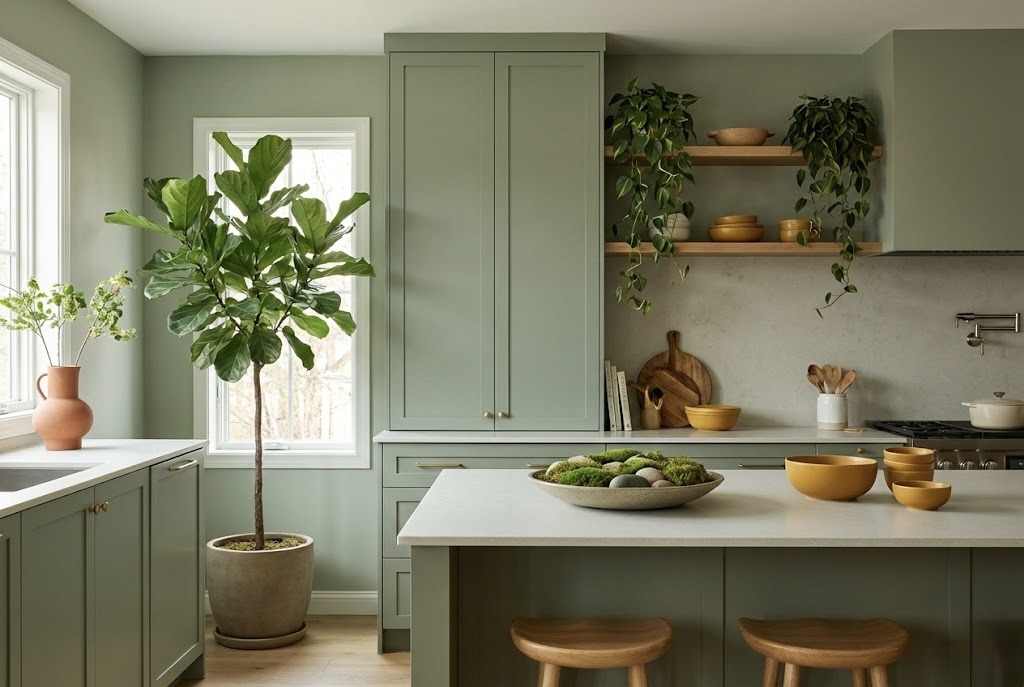
Example of using sage color within the 80/20 rule.
February Ritual Tip
Micro-Moss Corner
Find a corner where you drink your morning coffee and create a nervous safe-space there. A comfortable armchair, one plant at eye level, and a dish with moss and a stone.
This corner isn't Instagram-ready.
It's ready for your survival until the first spring days.
Conclusion
Home as an Antidepressant
Design in 2026 isn't about what's currently "in", but about how we feel in our space. Find one corner that will greet you with color for the first time in March.
Sometimes the shortest path to a better mood is through the color spectrum in the living room. Terracotta isn't just a color – it's the warmth of the earth. And sage isn't just a pigment – it's a breath in a deep forest.
Home doesn't have to be perfect. It just needs to be on your side.
Question for Readers
Which corner of your home would deserve more "forest" right now in February?