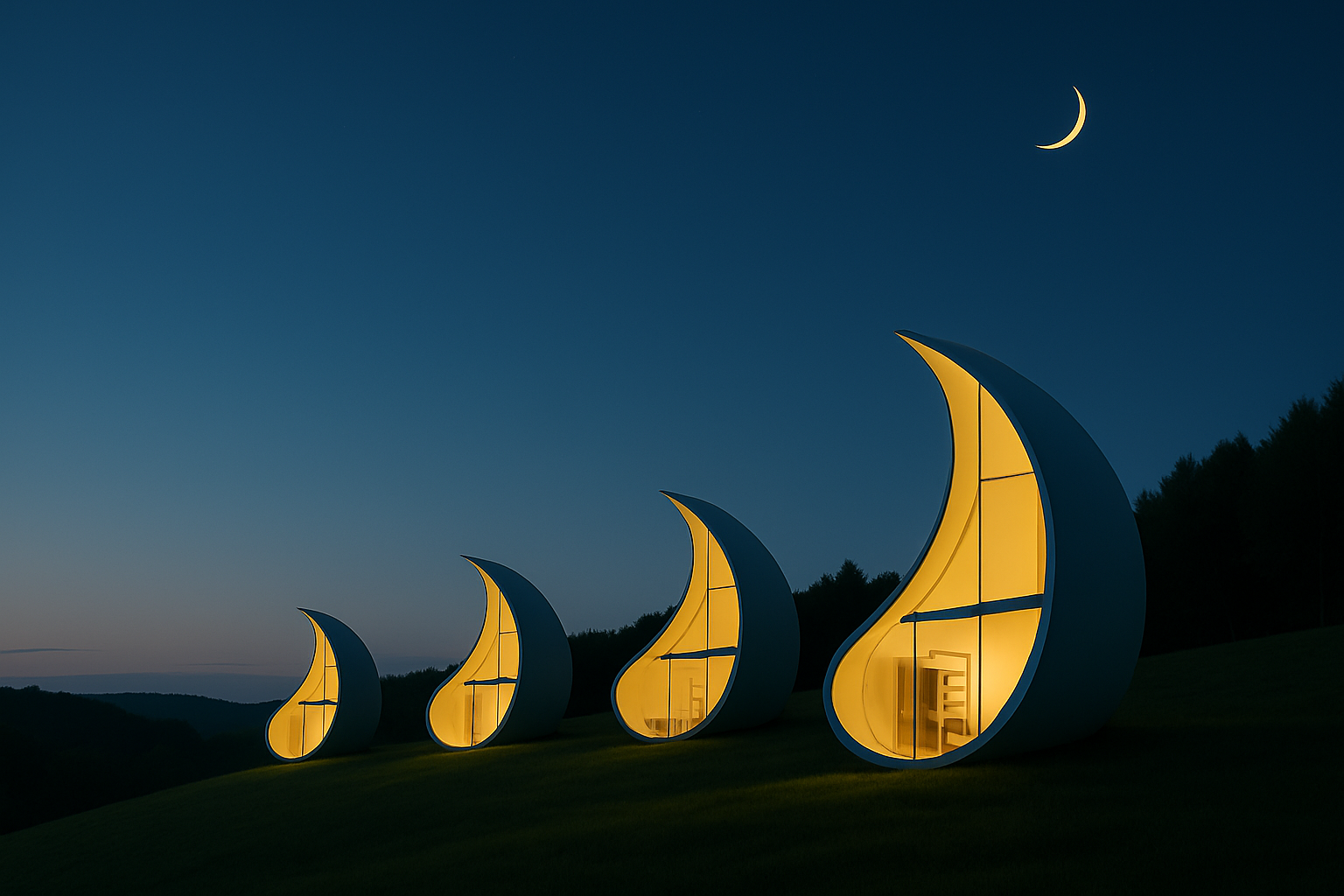
Elysium Moonhill isn't a hotel.
It's not a development project either.
It's a vision of quiet lunar sanctuaries – homes that don't shine for effect, but for the soul.
We contemplate how buildings could look that don't disturb the landscape, but breathe with it.
This is our manifesto. And perhaps the future we deserve.
1. Why Moonhill?
On a slope where only trees and silence once grew, a vision of sanctuary emerges – Elysium Moonhill.
Organic lines of houses, shaped into gentle lunar crescents, curve along the contour like a poetic calendar of time.
Each house is a phase. Each inhabitant – a light bearer.
Moonhill isn't about luxury.
It's about calm, darkness, light, and the touch of the cosmos.
It's a place where architecture doesn't stand against nature, but becomes its rhythm.
2. Three crescents – three dreams
Formal continuity
Houses flow like a lunar orbit.
Without sharp transitions, just the flow of light and shadow.
Architecture here isn't an object – it's a gesture.
Emotional minimalism
Interiors yield to inner calm.
Glass and concrete don't feel cold – they become a gateway between the world inside and the cosmos outside.
Each house is an inner temple of silence.
Nocturnal illumination
After dusk, each house transforms into a lunar body.
They shine according to the inhabitants' inner rhythm – some dawn, others remain in twilight.
The entire hill comes alive with a quiet choreography of light.
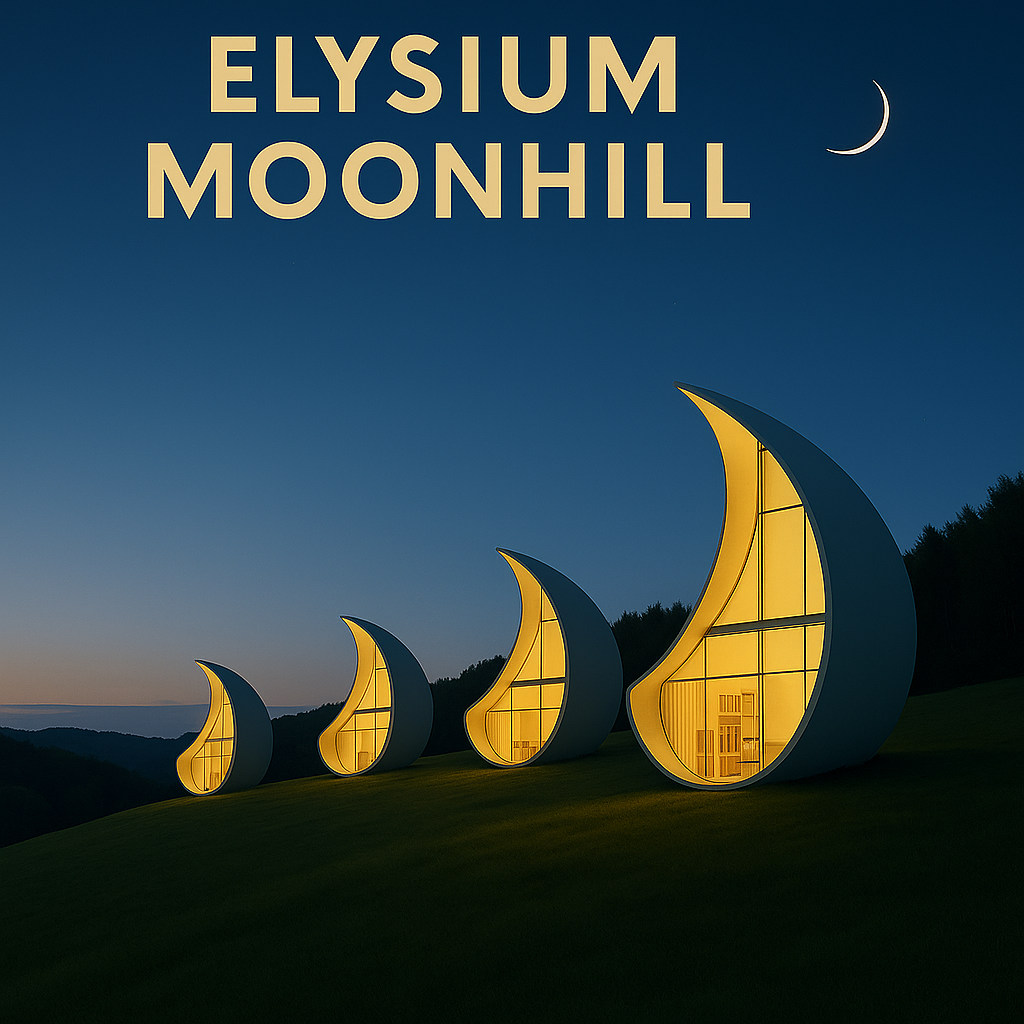
3. Four crescents of dreaming
Luna Silens – for those seeking silence
Aurora Lux – for lovers in moonlight's brightness
Noctelle – for pilgrims who want to be held by darkness
Soluna – for solitary creators who create in shadows
Each MoonPod is light that fell from heaven – and decided to stay.
4. Elysium as a way of being
Elysium MoonPods aren't hotels.
They're not houses either. They are fragments of the moon that landed on earth
and quietly offered sanctuary to those seeking more than accommodation.
They are for lovers. For pilgrims. For the lost.
For those who don't believe in luxury – but in light.
And in all of that — human. Small. Yet enormous."