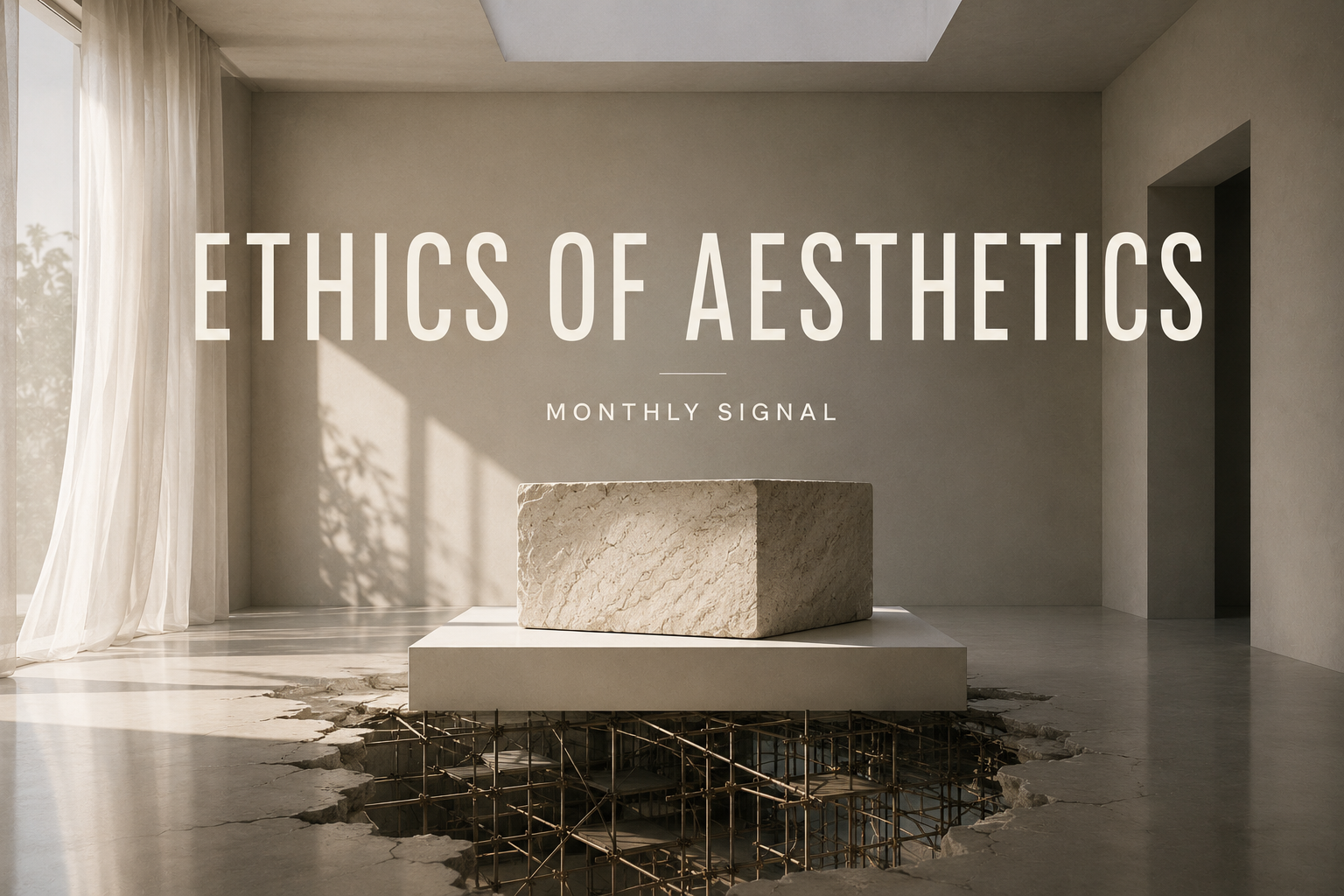
When we browse interior magazines, design exhibitions or perfectly curated social media profiles, the most common mantra we hear is simple:
"That's beautiful."
Aesthetics has become the universal currency of the modern world. But what exactly do we not see when we look only at the surface?
With this piece, we are deliberately turning the lens towards what the design mainstream would rather not look at. Towards the moment when beauty is put under the lamp and asked to show its papers.
Beauty as Status vs. Beauty as Responsibility
Creating an aesthetically perfect environment has become a modern symbol of status. We present our homes as a reflection of our own cultivation, taste and lifestyle.
But real design should not be a self-serving stage set.
Beauty without responsibility is nothing but empty formalism.
The question of our times is no longer merely:
"How do things look?"
But rather:
"At what cost were they made — and what impact do they have on the people who live in them, as well as on those who built them?"
The Aesthetics of Cheap Labour and Material as Guilt
We admire the massive stone slab, the clean line of raw concrete, or the generous glazed expanses of modern lofts.
Yet these very things are also resolved daily on the other side of construction site fences.
Cheap labour from abroad. People working without basic safety conditions. An invisible chain of exploitation that stays well outside the frame of perfectly lit photographs.
Behind every "accessible luxury" there may be an ethical debt.
If the perfection of one space is paid for by the disregarding of human dignity at the other end of the street — or the planet — we must ask:
Is this really beauty?
Or just a well-lit problem?
Sustainability Without Posturing
The word "sustainability" has become one of the most hollowed-out marketing terms of this decade.
The visual posturing of ecology — a combination of recycled plastic, beige tones and one fig tree in the corner — often masks the fact that it is simply yet another mass-produced item with a short lifespan.
True sustainability in design does not shout. It is quiet.
It reveals itself in:
- durability,
- repairability,
- craft integrity,
- local production,
- and the courage not to create yet more unnecessary visual noise.
Perhaps that is precisely where design is beginning to be real again.
The next time you say:
"That's beautiful."
Try to pause for a moment.
Where did that material travel from? Who stood on the scaffolding for that space to come into being? And does that object truly need to exist in the world — or does it only need our ego?
Design in 2026 can no longer live in a bubble of unawareness.
Real beauty begins precisely where blindness ends.
What About You?
When you look around today at the things you surround yourself with — how many of them are truly beautiful beneath the surface as well?
Write to us via the Grain of Design contact form.