You're sitting on a tram. The air is heavy, the seats have a questionable history, and in your light-colored coat, every kilometer feels like a silent punishment. One question keeps running through your mind: "Is this really the best we can do as humanity in 2026?"
Then you step outside, wanting to catch your breath, but there's nowhere to sit. The benches have vanished.
Welcome to the reality of modern cities. Instead of making spaces safe, clean, and welcoming, city councils have chosen the easiest path: remove the source of the "problem." No bench = no people sitting on it. Problem solved, statistics are clean, congratulations.
But we who live in these cities just want to pause for a moment and look at the trees. That's not a luxury, it's a basic human right. That's why, as part of the Urban Lexicon, I'm introducing a concept that doesn't take control away from cities but gives them back their soul.
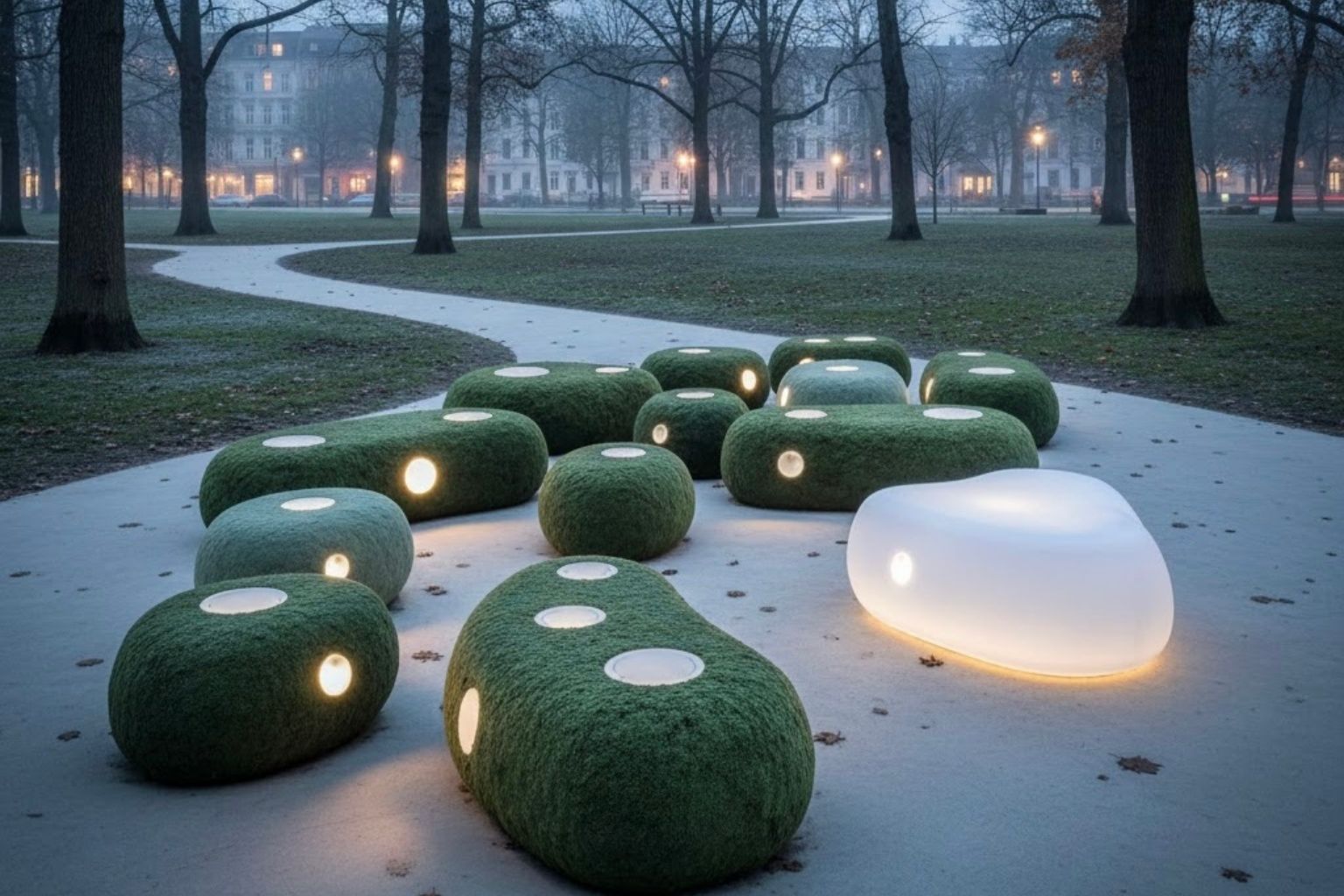
Meet Moss Lights.
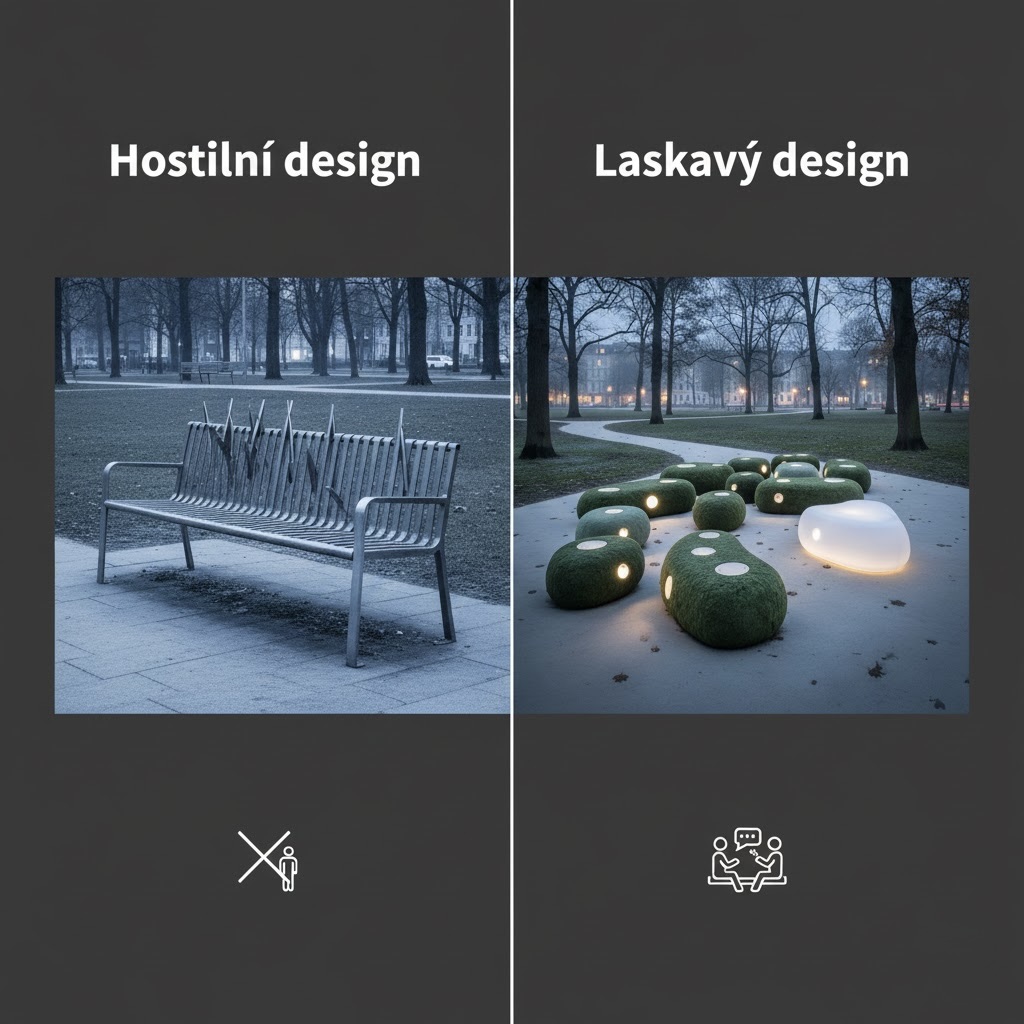
Hostile design punishes the presence of people. Kind design invites them to stay a little longer.
Moss Lights: A Micro-Pause Between Two Worlds
Moss Lights aren't benches in the traditional sense. They're "park providers of calm". A spot for moments when you don't want to pay for overpriced coffee at a café, but you're also not planning to spend the whole afternoon in the park. It's a micro-refuge.
A Shape That Doesn't Disrupt, But Tells a Story
Forget endless rows of concrete monoliths. Moss Lights form clusters of stools at various heights. They're arranged organically – like stones in moss or wave formations that create a subtle pattern in the landscape from afar.
- Various heights – some for regular sitting, others taller, the lowest ones serve as a surface for your bag or a cup of coffee.
- No backrests – a strategic move. No one will "sprawl out" on them at night, which reassures city planners, but you can still rest comfortably after a hard day.
Material: Rough at the Core, Kind on the Surface
Urban reality is harsh, so the core is made of ultra-high-performance concrete (UHPC) – indestructible and immovable.
Where your body touches, things change. The surface features a moss-like texture (such as recycled rubber granulate). It doesn't absorb water, doesn't rot, but feels organic to the touch.
Colors:
- sage
- olive
- deep forest
And occasionally one white "moss stone" as a landmark.
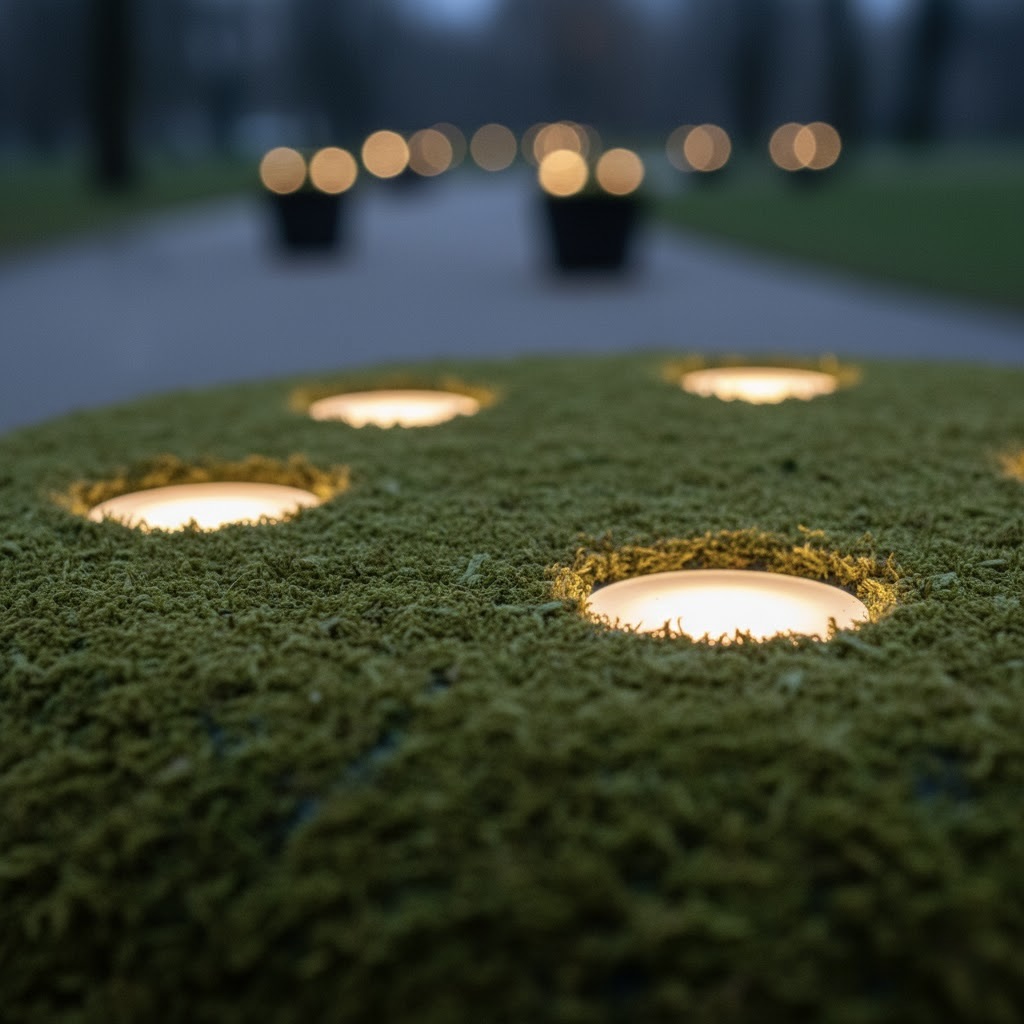
Light that doesn't blind but breathes. Micro-constellations on the surface of urban stone.
Fireflies in Concrete
The real magic comes after dark.
Moss Lights have integrated tiny LED points under opal glass. No aggressive spotlights or visual pollution. Just soft, pulsating light to guide your way.
In the park's map, dark corners are replaced by quiet light islands that resemble constellations on earth.
Treasure Stool: Treasures Hidden in the Moss
Design should serve everyone – including the little ones.
Near children's playgrounds, Moss Lights change colors to terracotta or soft blue. And among them, you'll find one special piece – the Nest Box.
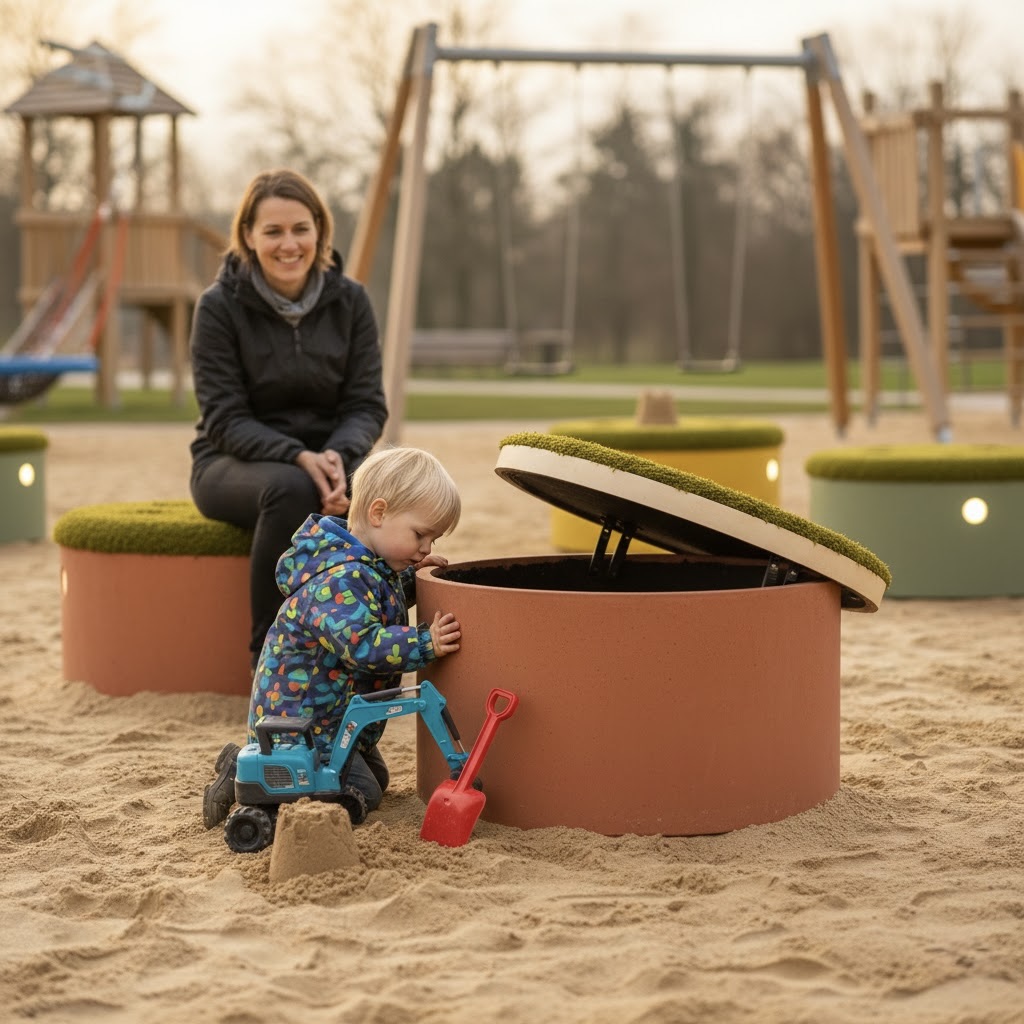
A neighborhood vault for molds and diggers. The toys here don't belong to one child, but to the whole playground.
It's a larger stool with a lid on gas struts (so little explorers don't pinch their fingers). Inside, there's drainage for rainwater and space for sand molds, diggers, and shovels that the neighborhood community can leave for others.
A small pictogram on the side signals: Treasures are hidden here.
How Moss Lights Live at Night (Technical Insert)
You might be wondering if this beauty is sustainable in practice. Moss Lights aren't just an artistic vision, but a thoughtful piece of urban engineering.
1. Hollow Body, Not a Solid "Rock"
Each "stone" isn't a massive block of concrete, but a shell made of ultra-high-performance concrete (UHPC). This ensures extreme durability (you can't just break it or carry it away), while creating space for technology inside.
A service hatch is hidden underneath, so technicians can replace modules at any time without having to "dig up" the bench from the ground.
2. Invisible Energy
To avoid disrupting the organic aesthetics with solar panels directly on the "moss," Moss Lights take the path of purity:
- Low-voltage network (24 V) – wiring runs safely under the park surface in conduits.
- Urban biorhythm – the lights are connected to the public lighting system. As soon as the first street lamps light up, Moss Lights quietly "breathe" into the darkness and begin to pulse.
3. Firefly Durability
The light source itself consists of recessed LED modules with high protection rating (IP67), protected by opal glass.
From the outside, you see only a clean circle of light – all the technology remains hidden inside the stone body.
Technically, it's a modular seating element made of UHPC with an integrated low-voltage LED system, bottom service access, and connection to public lighting.
The Moss Lights concept was created as part of my Urban Lexicon and is ready for a pilot installation in a real park.
More Than Just Seating
Moss Lights at path crossings, near water, or close to schools aren't just furniture. They're points of interactivity.
Simply scan a small QR code on the side and learn the story of that place, a short text from the Urban Lexicon, or perhaps a mini poem that slows your step.
Cities Shouldn't Punish Us for Being Tired
Cities shouldn't punish us for being tired. They should support us.
Moss Lights are my answer to the question of whether we can do better. We can. We just need to want to see more than statistics in our streets.
How do you like this concept?
Would you like to have "moss fireflies" in your neighborhood too?
And what else do you think a modern urban stool should be able to do?
Write to us through the form at grainofdesign.cz
Urban Lexicon is a living dictionary of the city. We're creating it together.