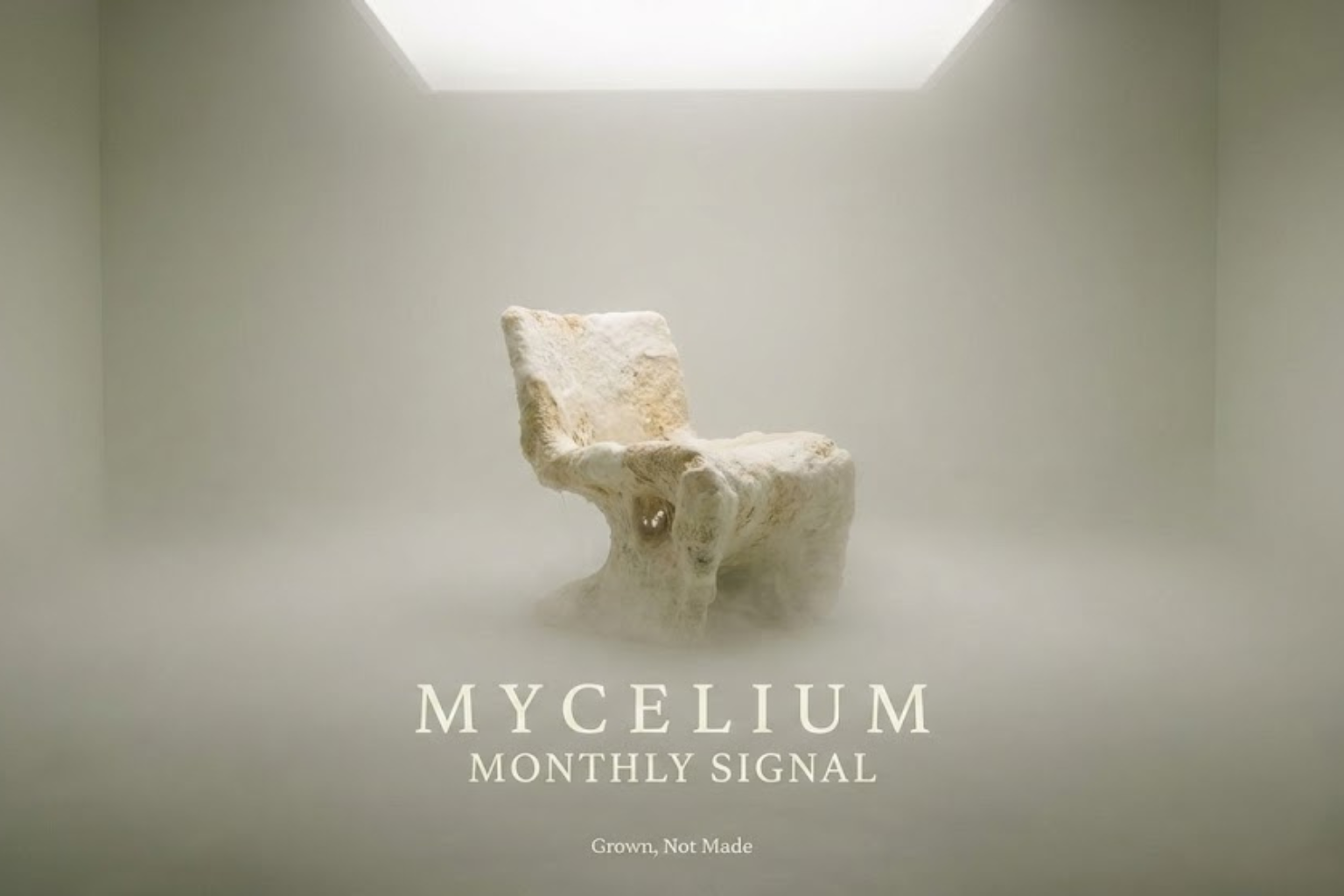
March – the Month When Things Start to Grow
March is traditionally associated with sprouting and the awakening of nature. But in 2026, this process is moving from fields and forests directly into design laboratories.
While February was about "fighting the gray," March is about radical growth.
Imagine not buying a chair cut from a tree, but a chair whose structure was woven for you by mycelium — the root network of fungi — in just a few days.
What Is Mycelium Design (Technology Without Chemistry)
Mycelium is the root system of fungi — a network that connects entire ecosystems in nature.
In design, it functions as a natural binder. Not like glue made in a factory, but as a living process that literally grows through and bonds the material.
The principle is surprisingly simple.
Agricultural waste — straw, sawdust, or hemp fiber — is placed into a mold and inoculated with mycelium.
Within a few days, it starts to grow.
The mycelium grows through the structure, strengthens it, and creates a lightweight, fire-resistant, and surprisingly durable material.
At the right moment, growth is stopped by drying.
The result is a composite without synthetic resins, without toxic binders, and without waste.
A material that doesn't end up in a landfill after years — but can return to the soil.
The Aesthetics of "Living" Furniture: The End of Perfect Sterility
Mycelium brings a new visual language to interiors.
One that is not based on perfection, but on naturalness.
Forget perfectly smooth plastics and materials trying to appear neutral.
Mycelium is not neutral. It is present.
Texture
The surface feels like something between velvet, leather, and cork.
It is finely fibrous, slightly irregular, and warm to the touch.
Color
The base palette is naturally creamy to ochre.
In 2026, experiments with natural pigments are underway — for example, from algae, bacteria, or mineral dyes.
Feel
It is design that doesn't feel like an object, but like an organism.
It doesn't look dead. It doesn't look final.
It feels as if it could keep growing.
Mycelium is not just a new material.
It is the end of the aesthetics of sterility — and the return of textures that are not under control, but in balance.
1. Why Designers Want Mycelium
In 2026, it's no longer about "green PR."
Mycelium appears in projects because it addresses a real material crisis in design.
Designers seek it for three main reasons:
Material fatigue
The market is saturated with perfect but lifeless materials. Mycelium brings variability — every piece is an original.
Radical carbon footprint
While concrete or steel emit CO₂ during production, mycelium stores it during growth.
New authenticity
In a digital world, there is growing hunger for origin. Mycelium tells a story about biological intelligence.
2. Curatorial Selection: Who Defines 2026
- MycoWorks — Reishi™ material ("mycelial leather")
- Myceen — interior elements and acoustics
- Aifunghi — first commercial furniture
- Studio TOOJ — mycelium + wood
3. Limitations: The Reality of the Material
Moisture
The material is porous.
Construction
Excellent in compression, weaker in tension.
Production tempo
Growing takes weeks. Mycelium forces you to slow down.
4. The Future: Cultivated Architecture
Living structures
Walls grown as a monolith.
Extraterrestrial design
NASA is testing mycelium for Mars.
Regenerative architecture
Buildings that decompose.
5. When Design Doesn't Describe the Future, but Designs It
Author's Concept: SYMBIONT 01 & NUCLEUS — A Grown Solitaire
After months of following mycelial design, a question emerged: what happens when we start designing growth?
SYMBIONT 01 — A Sensory Refuge
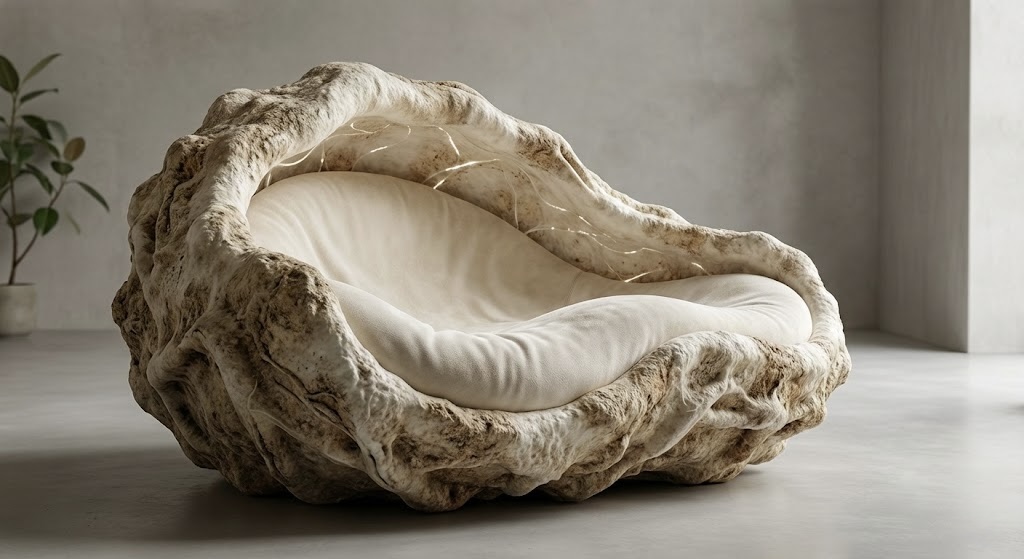
The mycelial organic cocoon SYMBIONT 01 is a sensory refuge.
There are no legs or screws. It is a monolith.
The outer surface is rough. Inside, a delicate mycelial skin provides contrast.
Its function is not primarily sitting, but stopping.
SYMBIONT 01 is a meditative solitaire.
Detail: optical fibers or bioluminescence are grown into the structure.
Design here doesn't approach manufacturing, but biology.
NUCLEUS — A Biological Gem
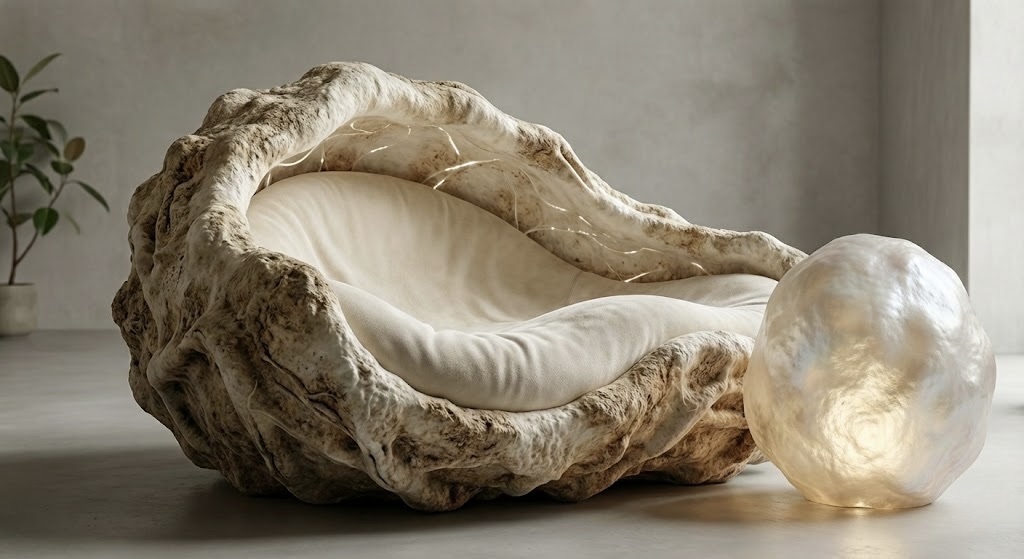
A lamp is not just a source of light. It is a technological manifesto.
The object is created from lab-grown nacre (mother of pearl).
An iridescent surface with optical depth emerges.
NUCLEUS shows that sustainable design doesn't have to choose between ethics and luxury.
SYMBIOSIS
Together they form a system.
Millions of years of evolution.
Materials of the future.
A cozy, safe nest.
Grown, not made.
Grown, not taken.
Conclusion: Your Home as an Ecosystem
March 2026 shows that the boundary between built and grown is dissolving.
An interior stops being a collection of objects and begins to function as a system.
Mycelium is not just a material. It is a shift in perspective.
Design moves from control to collaboration.
From manufacturing to cultivation.
From permanence to cycle.
Suddenly it makes sense that a chair can have an origin.
That a wall can be grown.
That a material can carry time.
The future of interiors may not be defined by style, but by metabolism.