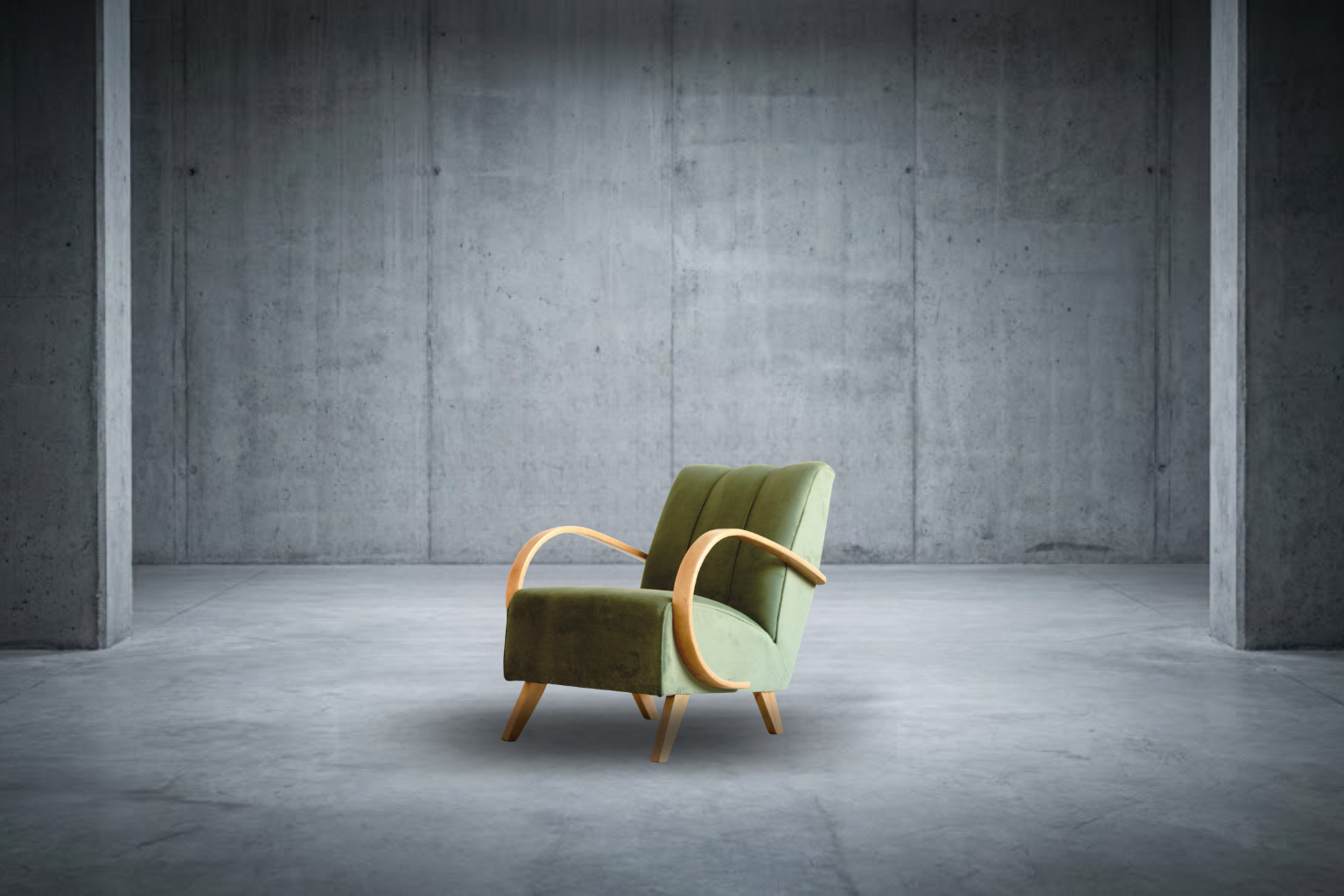
From overflowing warehouses to design that never dies — circular furniture 2026
We live in a time when buying a new table has become as trivial as ordering a takeaway coffee.
A click takes a second.
Delivery takes two days.
The product's lifespan? Often just two years.
We are witnessing global furniture fatigue — the market is saturated with an anonymous mass of chipboard and cheap plastic objects designed for quick consumption, not for inheritance. While manufacturers' warehouses burst at the seams with unsold goods that often end up being destroyed, we have resigned ourselves to having no relationship with our things.
It's economically and psychologically easier to throw away an old dresser and replace it with a new flat-pack than to invest time in repairing it.
But the linear model of "extract — produce — discard" has hit its ceiling.
The real challenge of 2026 is not to produce another chair.
The real challenge is to learn to let the one we already have live.
Overflowing warehouses: the reality we don't see
Imagine a warehouse.
Shelves reaching the ceiling.
Thousands of flat-pack boxes.
And among them — mountains of chairs, tables and cabinets that nobody wants. They're not broken. They're just… no longer trendy. Or they don't fit in the apartment. Or they simply stopped being "good enough."
In Europe, over 11 million tons of furniture end up in landfills or incinerators each year. Approximately 3% is recycled. The rest is burned or buried.
This is the era of furniture fatigue.
Not a crisis of aesthetics. A crisis of the system.
The chipboard tsunami: the overproduction crisis
Just ten years ago we celebrated accessibility:
"Cheap furniture for everyone."
Today we see the consequence.
Cheap production, quick purchase, instant dissatisfaction.
The world is flooded with things nobody wants to own for more than a few years.
It's cheaper to produce a new chair than to repair one.
It's cheaper to produce a new collection than to deal with what happens to the old one.
Manufacturers know it.
We know it.
And yet we keep doing it.
The question is no longer:
"What chair should I buy?"
The question is:
How do we go from being owners of things to users of values?
What to do with unsold furniture in 2026?
Anyone who has worked in retail knows the moment.
The new collection arrives. The old one goes on 70% sale. And still, some pieces remain.
What do you do with them?
In 2026, a "Made in EU" label is no longer enough.
Every piece should have a digital passport — a QR code or NFC chip with information about material origin, construction, repairability and recycling. European legislation (Ecodesign for Sustainable Products Regulation) is clearly heading in this direction.
The ethics of selling are changing:
from quantity to curation.
Instead of "we have 200 bed variants" we want to hear:
"This model will last you 20 years. And when it's done, you return it to us."
Pillars of circular design
1. Modularity as a lifestyle
Modular furniture grows with you.
A crib transforms into a desk.
A sofa for one expands.
A part wears out? You replace just that part.
Modularity is not a marketing term.
It's a strategy for longevity.
2. Material honesty
Solid wood.
Quality plywood.
Metal.
Stone.
Materials that age beautifully.
Cheap chipboard with melamine falls apart after a few years.
Solid oak matures.
Brands like Javorina in Slovakia have long proven that working with honest solid wood is not nostalgia, but a progressive choice.
3. Design for Disassembly (DfD)
No inseparable material mixtures.
No blind adhesives.
Screws, joints, clean mono-materials.
When a leg breaks, you replace it.
When a piece reaches end of life, it comes apart without violence.
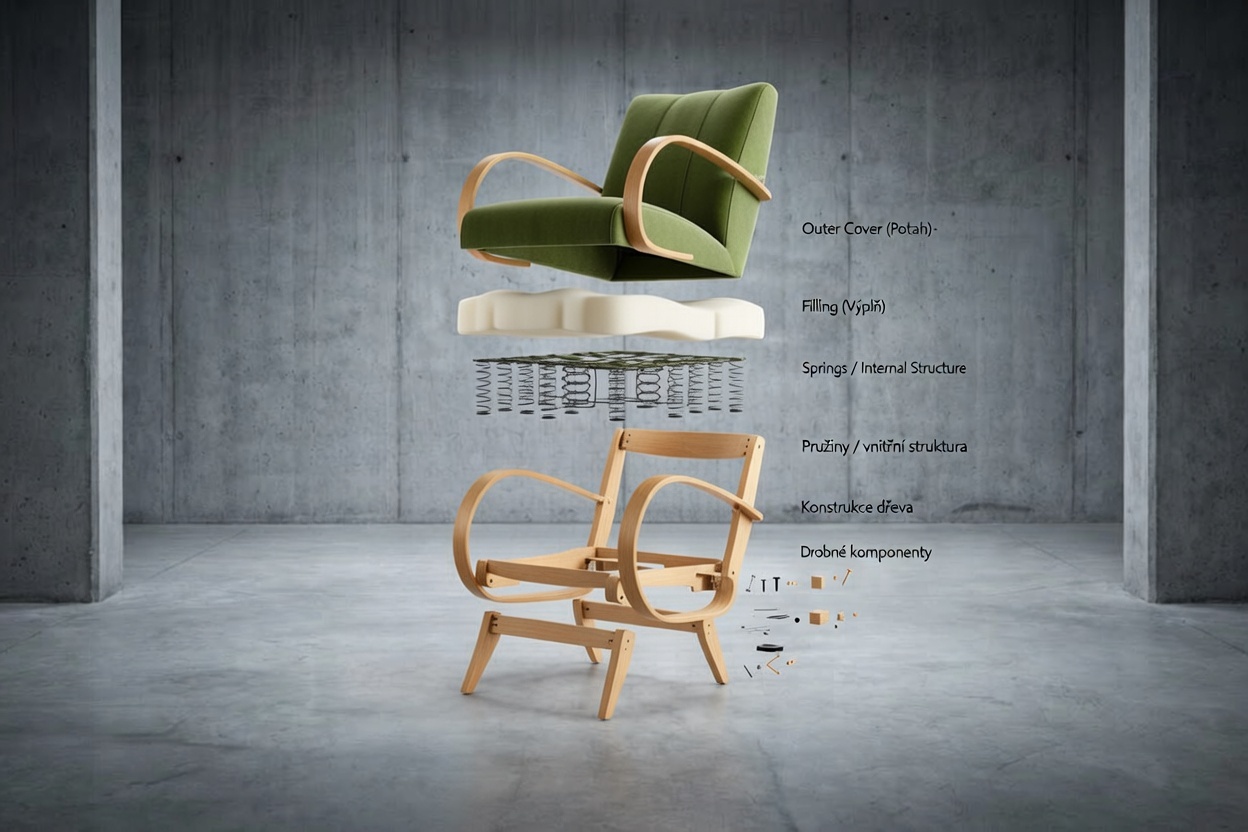
Every piece is a system — not a disposable object.
The renaissance of craft: from "throw away" to "improve"
While the big players deal with systemic changes, the real revolution is happening in workshops.
Restoration of vintage armchairs.
Reupholstering old sofas.
Rescued dressers.
This isn't just aesthetics.
It's resistance against anonymous overproduction.
Old solid wood furniture that has survived decades holds value that cannot be replicated by fast manufacturing.
Adapting an old piece for a new life requires time, knowledge and sensitivity.
And time is today's greatest luxury.
If a piece has history, it becomes immune to trends.
Sustainability then stops being a technical term and becomes an emotional relationship.
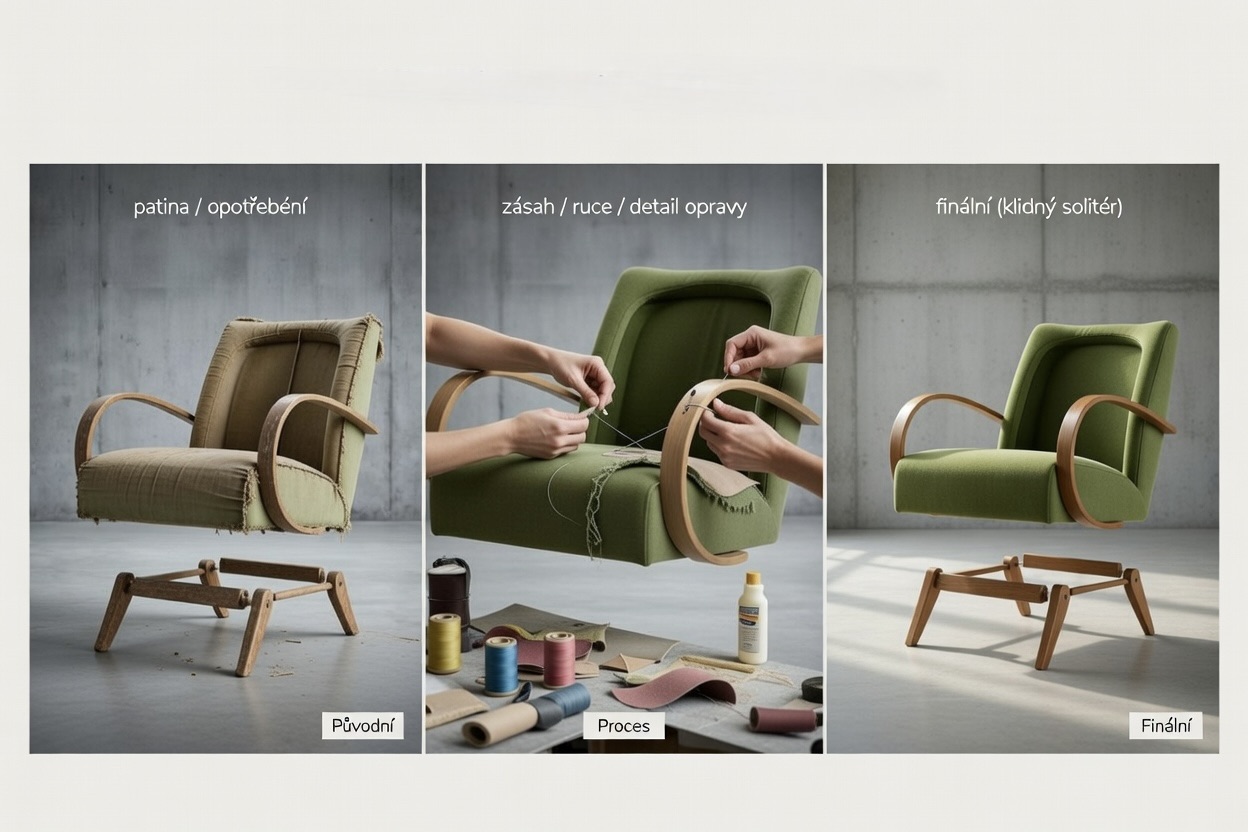
A second life is not nostalgia. It's a strategy.
From selling to servicing: new business models
Furniture as a Service (PaaS)
You rent a quality piece.
Your life changes? The company takes it back.
The Norwegian and Swedish model NORNORM is growing dynamically.
In the Czech Republic, projects like STO·RE and some showrooms are experimenting with re-use curation, combining sales with buyback.
The manufacturer is motivated to produce quality.
Because the product comes back to them.
Buy-back programmes
Responsibility doesn't end at the checkout.
IKEA is already testing take-back programmes in the Czech Republic. Other brands are considering similar models. The manufacturer buys back their product — and takes responsibility for its next life.
This is a system.
Not marketing.
Investing in silence
Circular design is not a restriction.
It's liberation from chaos.
In 2026, luxury no longer means owning the most.
Luxury means having fewer things — but ones that matter.
Buy one fewer chair.
But one that outlasts you.
Frequently Asked Questions (FAQ) — Circular Furniture Design 2026
What is circular furniture design?
Circular design is a way of designing furniture so that it can be easily disassembled, repaired, reused or recycled — without losing material value.
It's not just about ecology. It's about changing the system. Instead of the "produce — sell — discard" model, a "design — use — return — renew" model emerges.
The goal is not a seasonal trend. The goal is a lifespan measured in decades.
How does Furniture as a Service (PaaS) work?
You don't rent furniture because you can't afford to buy it.
You rent it because you don't want to own the problem.
You pay a monthly fee for using a quality piece.
When your life changes — moving, a child, different layout — the manufacturer takes the product back, renovates it and offers it to the next customer.
You pay for function.
Not for future waste.
Why is modular furniture better than traditional?
Because it accounts for change.
Modular furniture adapts to your life:
- a crib transforms into a desk,
- a sofa expands,
- a worn part is simply replaced.
You don't throw away an entire piece because of one part.
You buy a system, not a disposable object.
Is circular furniture more expensive?
Initially, yes.
Solid wood, quality plywood, metal joints and repairable constructions cost more than glued chipboard.
But over a 15–30 year horizon, it works out cheaper.
Because:
- it lasts,
- it can be repaired,
- it has residual value,
- it can often be returned to the manufacturer.
You pay once for quality.
Not repeatedly for frustration.
How to beat furniture fatigue in practice?
Start with small decisions:
- Buy less, but more consciously.
- Ask about lifespan, repairability and take-back options.
- Prefer solid wood and disassemblable joints over glued chipboard.
- Consider re-use and restoration.
- Support brands that think in cycles, not seasons (e.g. Javorina, STO·RE, or manufacturers with buy-back programmes).