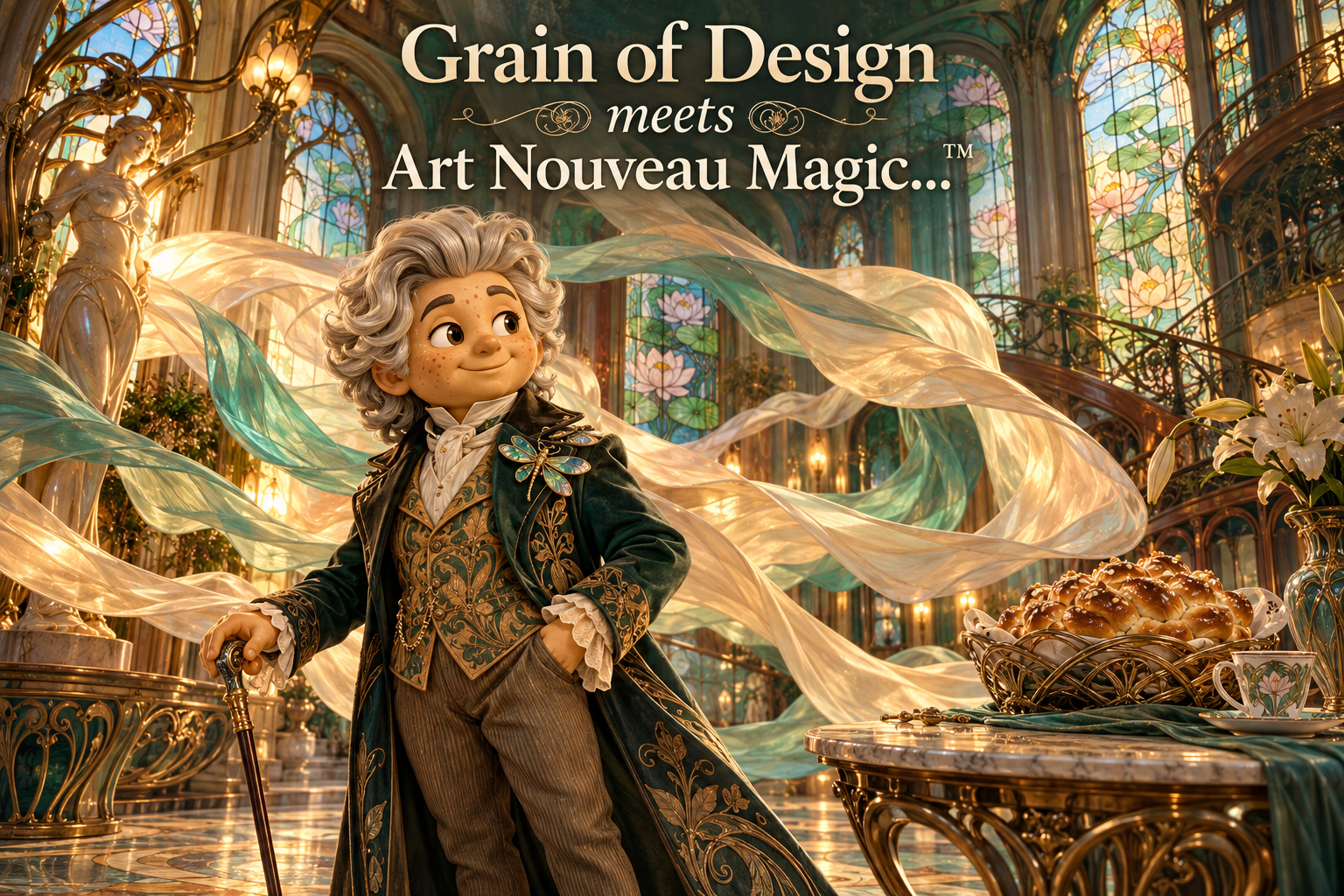
Pagáč tucked his strict neoclassical rulers deep into a drawer and took a long breath. The age of cold marble and right angles is over!
The turn of the century is here, bringing wild, untamed natural magic with it.
Suddenly everything flows, bends and ripples. Architects and artists cast aside straight lines and admire the curves of plants, the tendrils of climbing vines and mysterious shapes from the depths of the sea.
Pagáč stands in a Parisian salon surrounded by stained glass and bentwood. With a piece of springy, yeasted dough in his hand, he watches in wonder as the straight-edged world becomes an enchanted garden.
“Friends, this is no longer baking by the ruler! This dough has a life of its own — it ripples like seaweed and rises into the most incredible shapes!”
Pagáč on Inspection: Microscopic Jellyfish, the Magic of Light and a Japanese Secret
1. In the Naturalist's Study
Where did the Art Nouveau curve really come from?
Pagáč peers over the shoulder of German biologist Ernst Haeckel, who is drawing astonishingly precise illustrations of microscopic radiolarians and translucent jellyfish for his celebrated book Art Forms in Nature (Kunstformen der Natur) with almost reverent care.
Pagáč: “Ernst, I thought your famous Art Nouveau architects only drew water-lily stems and dragonflies from the garden! And here you are studying little creatures from the very depths of the ocean?”
Haeckel smiles and points to a detailed drawing of a jellyfish:
“My friend, nature is the greatest designer of all! Look at those delicate folds and supple movements. What people take for a merely decorative vine is actually the elegance of creatures the human eye cannot even see without a microscope.”
Pagáč: “Well, would you look at that! So that famous dynamic curve, the one that looks like a whiplash or a perfectly braided holiday loaf, was born hundreds of metres beneath the surface? Nature really is the finest baker of shapes!”
2. Backstage at a Parisian Theatre
The woman who made light and silk dance
American dancer and inventor Loïe Fuller bursts into the theatre's costume room. She carries long rods with metres of fine, translucent silk attached to them.
Pagáč: “Madame Fuller, are you about to bake giant meringues, or what are all these piles of white fabric for?”
Loïe Fuller beams, switches on coloured electric spotlights and sends the silk swirling overhead:
“Not meringues! With technology and dance, I turn light into living flames, butterfly wings and blossoming flowers. I even had my lighting tricks patented!”
Pagáč: “Incredible! You have created more than a chair or a vase for the table. You have created a magical world in which a person feels as if they are inside an oven filled with coloured light. Art Nouveau is not just a static ornament — it is a gloriously wild dance!”
3. In a Famous Parisian Gallery
Why is the new style called Art Nouveau?
Pagáč walks through the elegant gallery of Parisian art dealer Siegfried Bing, who is unpacking crates full of precious Japanese prints and little lacquered boxes.
Pagáč: “Siegfried, everyone in the streets speaks of ‘Art Nouveau’ as a new French marvel. Yet here you are unpacking things from the other side of the world?”
Siegfried Bing gently strokes a Japanese bowl:
“My shop is called Maison de l’Art Nouveau — the House of New Art. And this art draws enormous strength from Japan: its sense of asymmetry, its use of empty space and its respect for craftsmanship.”
Pagáč: “So ‘New Art’ got its name from one clever shop and the Japanese courage to put down the ruler? What a beautiful baker's irony. The best recipes often come from mixing ingredients from entirely different corners of the world!”
“Art Nouveau showed us a world where everything grows, ripples and breathes.”
“Being an artist does not mean only carving stone. It means being able to set light, fabric and human imagination rippling like well-risen dough.”
Visual Style
Natural magic, curling tendrils and cool stained glass
Colour Palette: Sensuous Nature
- Emerald Green:
#2A5A44— The deep, mysterious hue of a mossy forest and its stems. - Opal Lily:
#E8D8C8— A soft, creamy, pearlescent shade of flowers and silk. - Copper Sunset:
#B86D43— A warm metallic accent for curved lights and details. - Night Iris:
#3C324A— A deep, muted violet-blue for the mysterious atmosphere of stained glass.
Textures
A living organism
- Flowing wood and metal — materials bent into the shapes of plant stems.
- Colourful stained glass — glass through which light paints stories across the floor.
- Fine, translucent silk — fabric that ripples and responds to every breath of air.
- Organic motifs — dragonflies, water lilies, butterflies and mysterious sea jellyfish.
Pagáč's Art Nouveau Ten Commandments
Rules of natural magic
- Throw your ruler into a wicker basket — you will not find a single straight line in nature.
- Take inspiration from everything that grows, blooms or swims in the deepest sea.
- Metal and wood must not look hard — they should appear to have just grown from the ground.
- Light is not just a bulb. Light is magic passing through coloured glass.
- Asymmetry is natural. A flower in a meadow does not grow as a mirror image either!
- Every object — from a door handle to an enormous house — deserves love and the touch of a craftsperson.
- Do not be afraid to mix an idea from Japan with Parisian charm.
- Fabrics should ripple and dance, not stand still like a marble column.
- As dough rises, it finds its own shape — just like an Art Nouveau ornament.
- A home should feel like a magical garden where you can breathe easily.
A Question for Design Lovers
How do the flowing shapes of Art Nouveau make you feel?
Do you love the dreamlike atmosphere, organic lines, coloured glass and inspiration from nature?
Or is all that decoration too much for you, leaving you ready for the strict, clean style of the twentieth century?
Tell us in the Instagram comments: would you like an Art Nouveau fairytale garden at home, or do you prefer a calmer kind of minimalism?
Next Time?
Pagáč gently strokes a glass dragonfly when the noise of factory machines begins to rise around him. Natural tendrils give way to steel tubes, geometry and pure functionality. The machine age is coming…
Art Deco & Bauhaus — Beauty Versus Function™ — coming in November!
P.S. The Pagáč Edition 2026 collector's sticker is still available in our e-shop.