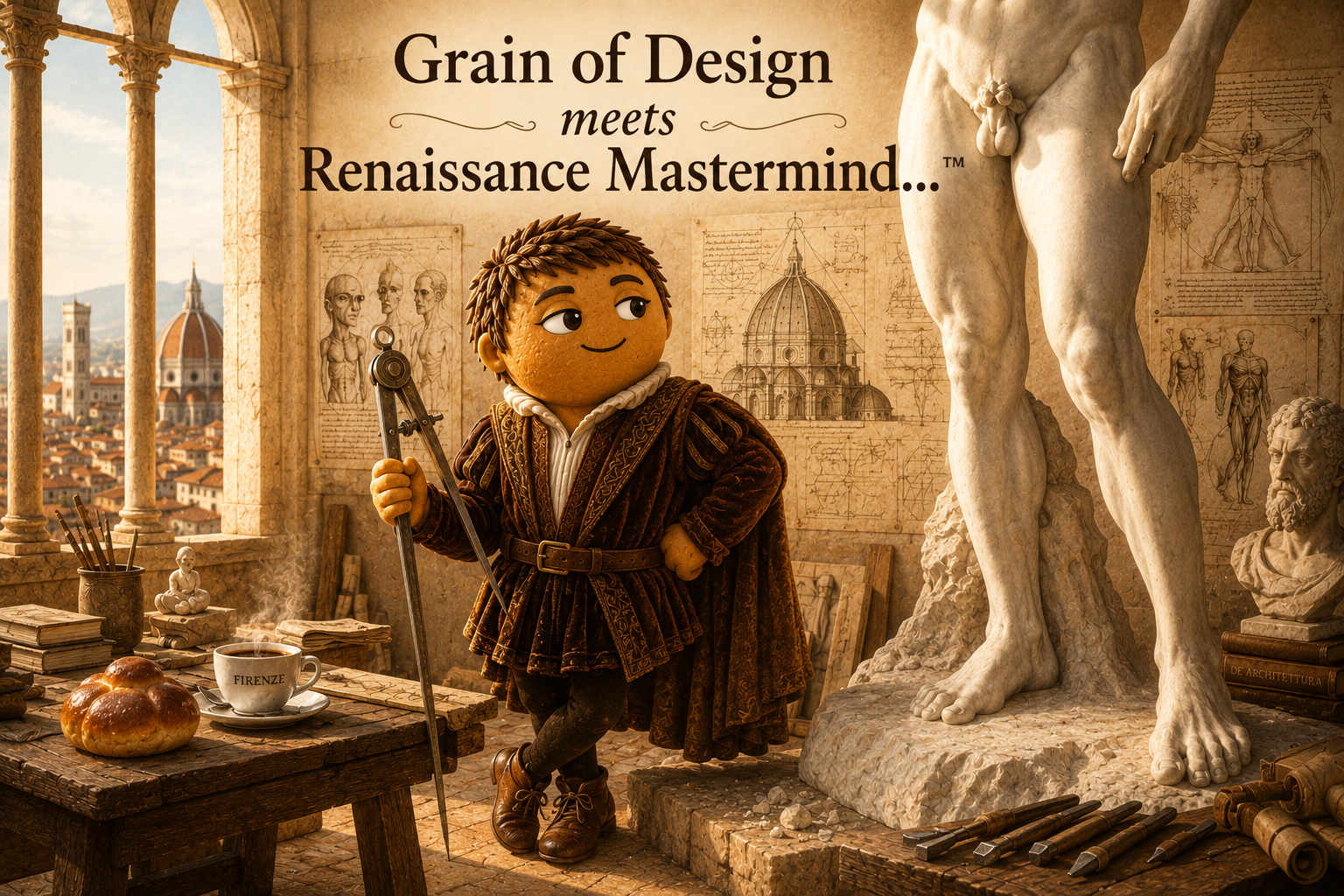
Pagáč cast off his medieval robe full of stone dust, slipped on a pair of elegant leather shoes, and stepped into Florence with the effortless grace of an Italian cavalier.
The Gothic chase after an unreachable sky was over. The age of reason, symmetry, human scale and… perfectly round shapes had begun.
While Brunelleschi was shouting across the entire construction site of Santa Maria del Fiore that the enormous dome would one day collapse on his head without any scaffolding, Pagáč sat nearby, sipping his morning espresso and studying the geometry of Michelangelo's David.
"Boys, that backside may be anatomically accurate, but it's missing that proper risen fullness," he remarked approvingly towards the famous sculptor. "The renovation of humanity surely can't begin with a muscle that has no crust!"
Pagáč on Inspection: Florence and Lessons in Proportion
1. At Michelangelo's David
Anatomy vs. the aesthetics of pastry
Pagáč walks around the freshly unveiled statue carved from Carrara marble. Michelangelo paces nervously around him.
Pagáč: "Mikey, listen. The lad is gorgeous. That marble has a texture as smooth as the finest type-00 wheat flour. But those proportions!
The golden ratio says one thing, but look at those hips. If I pulled the dough for a Christmas braid that tight, it would crack in the oven.
You need more roundness, more Italian lightness. A Renaissance man should look like he enjoys a good brioche, not that he survives on pure Renaissance faith alone."
2. Under Brunelleschi's Dome
The secret of the self-supporting vault
Filippo Brunelleschi gesticulates furiously over the plans for the enormous dome.
Pagáč: "Filippo, calm down. Have some wine.
Why are you building a double wall? Because you know that if it bakes too fast on the outside, it stays raw on the inside and the whole thing collapses.
That herringbone brick pattern is clever, but imagine it as braiding a bread roll. If you cross the strands correctly, it will hold the weight of the entire world — no scaffolding needed."
He then pauses, points at the dome, and utters a sentence architects have been writing down ever since:
"Architecture is just bakery on a grand scale."
3. In Leonardo da Vinci's Workshop
The Mona Lisa and the mystery of the smile
Leonardo is mixing paints. The Mona Lisa sits tiredly in a chair.
Pagáč: "Leo, that smile of hers... people will spend centuries wondering what she means by it.
And yet it's perfectly obvious. She has no secret. She's just hungry!
You've been painting her for three hours and you haven't given her a single piece of focaccia.
Add a little more warm, honeyed colour to the shadow around her mouth — so it looks like she just finished chewing the heel of a crusty loaf. That's what people will call sfumato!"
And somewhere in the corner of the workshop, Leonardo quietly writes in his sketchbook:
Note: Observations of a peculiar Florentine designer. It appears he translates all the geometry of the world into baked goods. Further study required.
Pagáč leaves and tosses one last remark from the doorway:
"Master, the flying machine is interesting — but have you ever considered a flying bread roll?"
"Proportions are the dance of reason with matter. When a thing has the right golden ratio, it doesn't need to shout to be noticed."
Visual Style: Harmony, Perspective and Warmth
Colour Palette: The Colours of Tuscan Sun
- Tuscan Terracotta (Tuscan Earth): The colour of Brunelleschi's fired bricks and perfectly baked bread.
- Carrara White: A luxurious, matte texture of pure marble with a subtle grey grain.
- Olive Grove: A muted, deep green that lends calm and harmony to any space.
- Golden Renaissance Brocade: The rich colour of Florentine sunlight, gold and luxurious fabrics.
Textures: The Perfection of Surface
- Smooth Marble: A matte, cool surface that reflects human intellect.
- Fired Clay: A rougher, warm texture of bricks that holds the heat of home.
- Linen Canvas: A natural, clean texture for master painters and humble dishcloths alike.
Pagáč's Renaissance Decalogue
Rules of the Golden Ratio
- Man is the measure of all things. So is his stomach.
- The dome is the crown of design. It must be round, symmetrical, and topped with a proper cherry.
- Perspective will save you. If your lines don't converge to a single point, your design has no direction.
- Symmetry is peace of mind. What you have on the left must carry its crispy weight on the right as well.
- Marble must speak. But it must not shout. Let its natural grain come through.
- The golden ratio is not a dogma — it's a recipe. Take a little away here, add a little there, and the result is perfect.
- Sfumato is baker's smoke. Blur the edges and the design will feel more mysterious and soft.
- Anatomy is the foundation. If you don't know what a skeleton looks like, you can't build a decent chair.
- Light and shadow create volume. Without shadow, even the finest bread roll is just a flat disc.
- When the master says it can't be done, make him an espresso. In the Renaissance, everything is possible with the right proportions.
A Question for Renaissance Designers
When you look at a modern interior, what gives you that true sense of harmony?
- Perfect geometry and clean lines, where every object has its precise mathematical place?
- Or warm materials and organic shapes that bring humanity and softness into the design?
Let us know in the comments whether you carry more of the soul of mathematician Brunelleschi — or the bon vivant Pagáč.
Next?
The light is beginning to break dramatically.
Pagáč puts on his wig, picks up a gilded mirror, and sets off towards Versailles.
Baroque is knocking at the door — an era where modesty was a sin and whipped cream flowed in rivers.
Baroque Extravaganza ™ – coming soon!
P.S. Just a reminder that our collector's Pagáč Edition 2026 sticker is waiting for you in the e-shop. Pure proportion. Perfect detail.