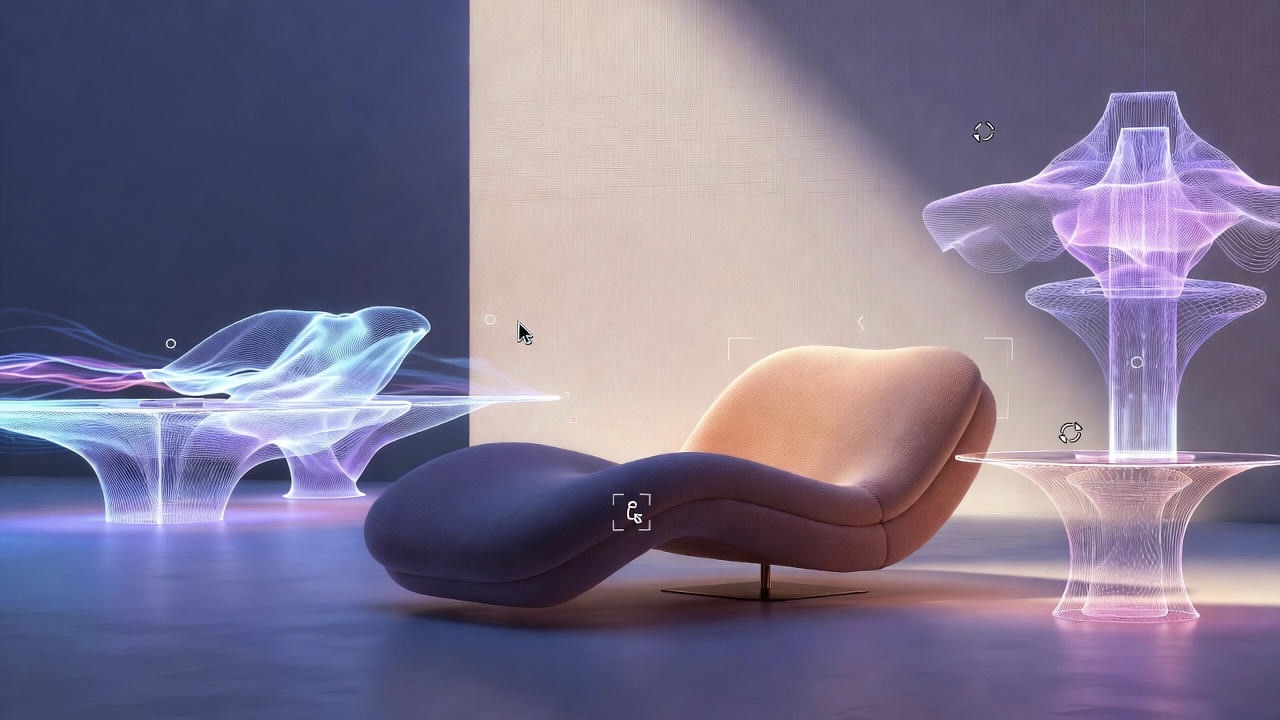
ᴳᴰ Visualisation created using generative AI · Concept and creative direction: Grain of Design
Furniture That Doesn't Exist
While interior design has focused for years on tangible and sustainable materials, a new, radical trend has emerged in recent years: virtual and speculative furniture.
Designers and architects with renowned names (from Zaha Hadid Architects to young digital creators) now design chairs, lamps, and entire rooms that exist only as data – often as non-fungible tokens (NFTs) or 3D models.
Why are global companies paying for pieces that will never leave digital space? And how will this physico-digital trend influence how we will live and design in 2026?
What's Actually Happening?
Let's admit it – it's fascinating, but also a bit absurd.
"Speculative design" is an approach that explores what things might look like in the future. In the context of furniture, this means:
- designing pieces that are too expensive, environmentally demanding, or logistically unfeasible to produce in the real world,
- using virtual prototyping to push the boundaries of materials, gravity, and functionality without risk and waste.
This approach is used, for example, by the studio Zaha Hadid Architects (ZHA) for testing futuristic constructions that would be extremely demanding in the physical world.
Designers thus showcase their vision and creativity. They don't need any raw materials, transportation, or storage. Virtual pieces are sold as limited edition NFTs. The buyer doesn't get a physical piece of furniture, but digital ownership and exclusivity of the given design.
You can buy 3D armchairs, lighting, and even entire rooms. Today's software enables modeling almost at the level of sculpture, detailed texturing, and top-quality photorealistic rendering – from rough concrete through worn leather to completely new types of textiles. Organic and "liquid" shapes will never cease to surprise you.
The designer no longer works with reality, but with the illusion of reality. In the metaverse, they can ignore gravity, strength, and assembly complexity. They become a storyteller – creating more of a story and atmosphere than just a functional object. It's a change in approach and thinking, but also liberation from physical limitations.
Why Do People Buy This?
On various platforms, people build digital identity and furnishings for virtual homes. Buyers acquire furniture for their avatars and, similar to how collectors invest in art, they invest in virtual furniture.
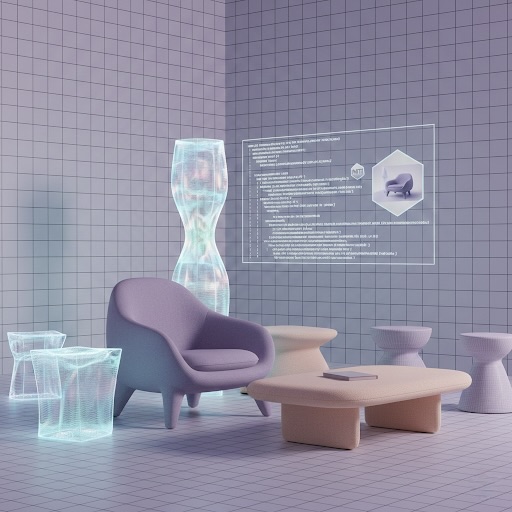
Virtual living room: physical armchair, digital furniture and NFT panel with parameters.
Prices of some limited NFT pieces reach tens of thousands of dollars, which underscores their collectible value. For example, the digital armchair "Hortensia Chair" by designer Andres Reisinger became an icon of this trend and showed that digital design can have comparable value to physical art.
NFT (non-fungible token) is essentially a digital certificate of ownership and authenticity stored on blockchain, even though the object itself exists only as a file.
What Does This Do to Furniture Design?
Through your mobile phone, you can now display a digital 3D model of an armchair directly in your living room before you decide on a physical purchase.
Furniture in digital form doesn't have to be ergonomic – it can be purely emotional, poetic, or conceptual. It's "architecture for avatars".
The designer sells their concept before the physical product is created. They test people's reactions to proposed shapes, colors, and materials that don't yet exist in the real world.
If a client buys a real product, they can simultaneously gain the right to own the digital version of the selected piece, which they then use in any metaverse. This increases the value of both products – especially for limited editions made to order.
And What About Those of Us Living in Real Apartments?
Where does real value lie?
If at home I physically sit on an affordable IKEA chair, but in the metaverse I own a limited, futuristic lounge chair worth 3 ETH… where do I actually "live"?
Where does my real identity lie – and where am I actually investing in my "home"?
Furniture that doesn't exist confronts us with its non-functionality:
- a virtual armchair won't support me when I have a fever, nor will it provide physical comfort,
- I can't turn a digital lamp toward a book I'm reading on a real table.
The value of NFT furniture therefore doesn't lie in function, but in symbol, status, and digital identity. It's a visual beacon in online space that reflects the owner's ambitions and taste – regardless of what their physical living room looks like.
Laboratory of the Future – or Dead End?
Virtual furniture is also a laboratory – a place where future shapes are born that may one day spill into the physical world. It's a legitimate form of art and functional design. It forces us to think about aesthetics and functionality without the limitations of physical laws.
For interior studios in 2026, this means being able to offer clients not only a real but also a digital view of their space – and being ready to integrate digital ownership into traditional sales.
Virtual furniture won't feed us or hug us.
But perhaps it's the sketchbook of the future.
Questions That Remain
Are you ready to pay for furniture you can't physically touch?
Maybe yes – if you don't perceive it as furniture, but as art and digital identity. A virtual armchair won't seat you, but it can be a symbol, collector's piece, or calling card in online space. It makes sense to pay for it when you consciously buy a story, status, and designer's vision, not a functional object for your living room.
And can virtual design (freed from physics) actually inspire innovations in real, sustainable design – or does it rather distance us from it?
It can do both. When used as a laboratory of ideas, it can bring new shapes, material concepts, and approaches that then transform into a real, thoughtful product. But if virtual design becomes just speculation and hunting for the next NFT, it disconnects from reality, ergonomics, and sustainability. The key is whether we take it as a sketchbook of the future – or as an escape from the physical world.