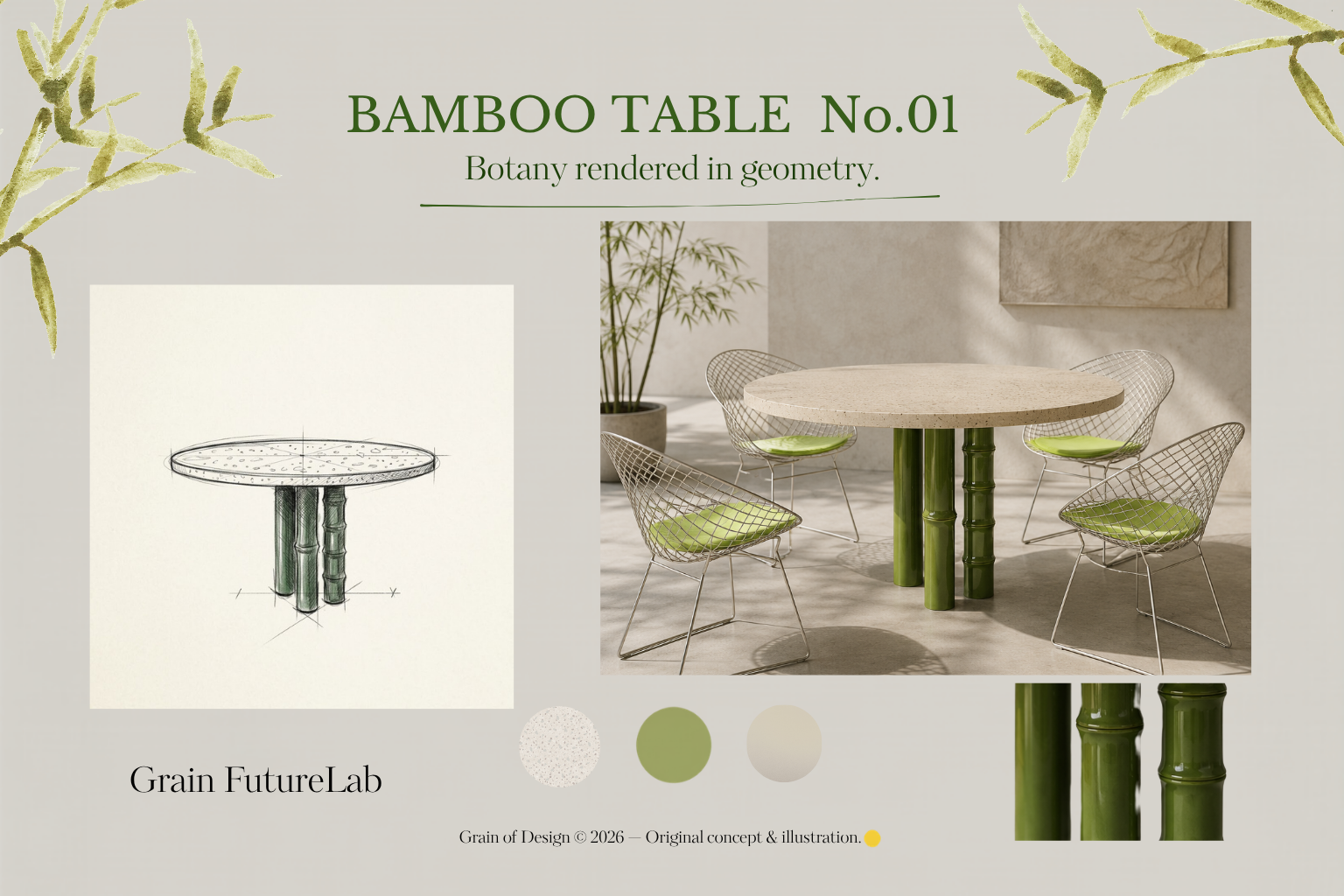
From My Sketchbook
Not every idea begins with the intention of being built tomorrow.
You are looking into my sketchbook.
This is not a finished project. It is a thought captured in a moment.
An experiment.
A reflection.
One of the paths design thinking can take.
I remembered the light between the bamboo. At first, a table did not cross my mind at all. I was thinking about verticals, about that particular rhythm of green stems with light passing between them.
What if I tried to bring that rhythm into furniture?
The first thought was simple. A round top. Three cylinders beneath it.
But three identical cylinders felt too ordinary.
So I gave each one a slightly different character.
I did not want to design a table that looks like bamboo. I wanted to create a table that brings into an interior the same light I experienced among the bamboo.
Light passing between the stems draws irregular shadows on the ground and lets the space breathe.
Somewhere in that moment, BAMBOO TABLE was born.
Nature as Engineer
Bamboo is more than a material.
It is nature’s structural logic.
In a way, it is a beautiful green pipe.
Light. Strong. Hollow. Flexible. Renewable.
Nature refined its structure over millions of years. Today, people can study and imitate it, and look for ways to carry its principles into their own designs.
But I was not interested only in bamboo’s strength.
I was interested in its spatial geometry.
Vertical rhythms.
The light between them.
Air.
Lightness.
The possibility of looking through.
I wanted to translate these qualities into a simple geometric object. Not by literally imitating nature, but by respecting its natural elegance.
Two Distinct Characters
BAMBOO TABLE is built around the contrast between two markedly different elements.
The tabletop is calm.
A circular surface approximately 120–140 cm in diameter, conceived in light natural stone.
I imagine its thickness at between 20 and 25 mm.
Its colour sits somewhere between travertine, limestone and a subtle terrazzo.
No prominent stone fragments or dramatic veining.
Only fine mineral grains, an almost invisible texture and a matt surface that softly diffuses light.
The tabletop is not meant to dominate.
It should make space for what happens beneath it.
Three Legs. Three Personalities.
The base is made up of three green cylindrical elements grouped close to the centre of the table.
Using real bamboo would have been too easy. But I did not want to work with bamboo as a material. I wanted to work with its geometry. To preserve the rhythm of its nodes while freeing it from the plant itself.
At first glance, they appear to form a single whole.
Look closer, though, and you will see that no two are alike.
Three vertical forms that refuse to hide, yet still let the tabletop stand out.
Leg I — Silence
Perfectly smooth.
No breaks, no nodes.
One long, clean cylinder.
The simplest of the three.
Leg II — Rhythm
One distinct node.
A subtle interruption in the smooth surface that changes its character.
The same colour. The same sheen.
A different geometry.
Leg III — Story
Four joints.
Two close together.
A gap.
Then two more.
The rhythm of a real bamboo culm translated into a form on the edge between nature and architecture.
One colour brings all three legs together.
A saturated bamboo green that deepens in the shade and almost glows in direct light.
The glossy finish emphasises their volume and creates another contrast with the matt stone.
Three different elements carrying a single tabletop together.
Suddenly, it is more than a structure.
It is a small story hidden beneath the table.
Between Sketch and Reality
BAMBOO TABLE exists only as a concept for now.
Its proportions, materials and structural solution are all open to further development.
That is exactly what I enjoy about experiments like this.
A sketch does not have to answer every question. It can be a way of opening some up.
How will light reflect off the green surface?
Which material could best preserve the character of bamboo nodes?
And how can a structure be designed to carry a stone top without losing its visual lightness?
These are questions for the next stage of development and a possible prototype.
Today, BAMBOO TABLE is first and foremost a study of the relationship between nature, material and geometry.
And perhaps also a small reminder of the quality I admire most about bamboo.
The greatest strength is not never bending.
It is being able to straighten again after every wind.
Open Design Partnership
Some ideas take shape in a single afternoon.
Others wait until they meet the right person.
BAMBOO TABLE is one of them.
This concept is open to further development and potential collaboration with furniture makers, design brands, or specialists in materials and structural solutions.
If the design resonates with you and you see potential for shared development, prototyping or realisation, I would be glad to start a conversation about working together.
Or use the contact form on the Grain of Design website.
🟡 Grain of Design®