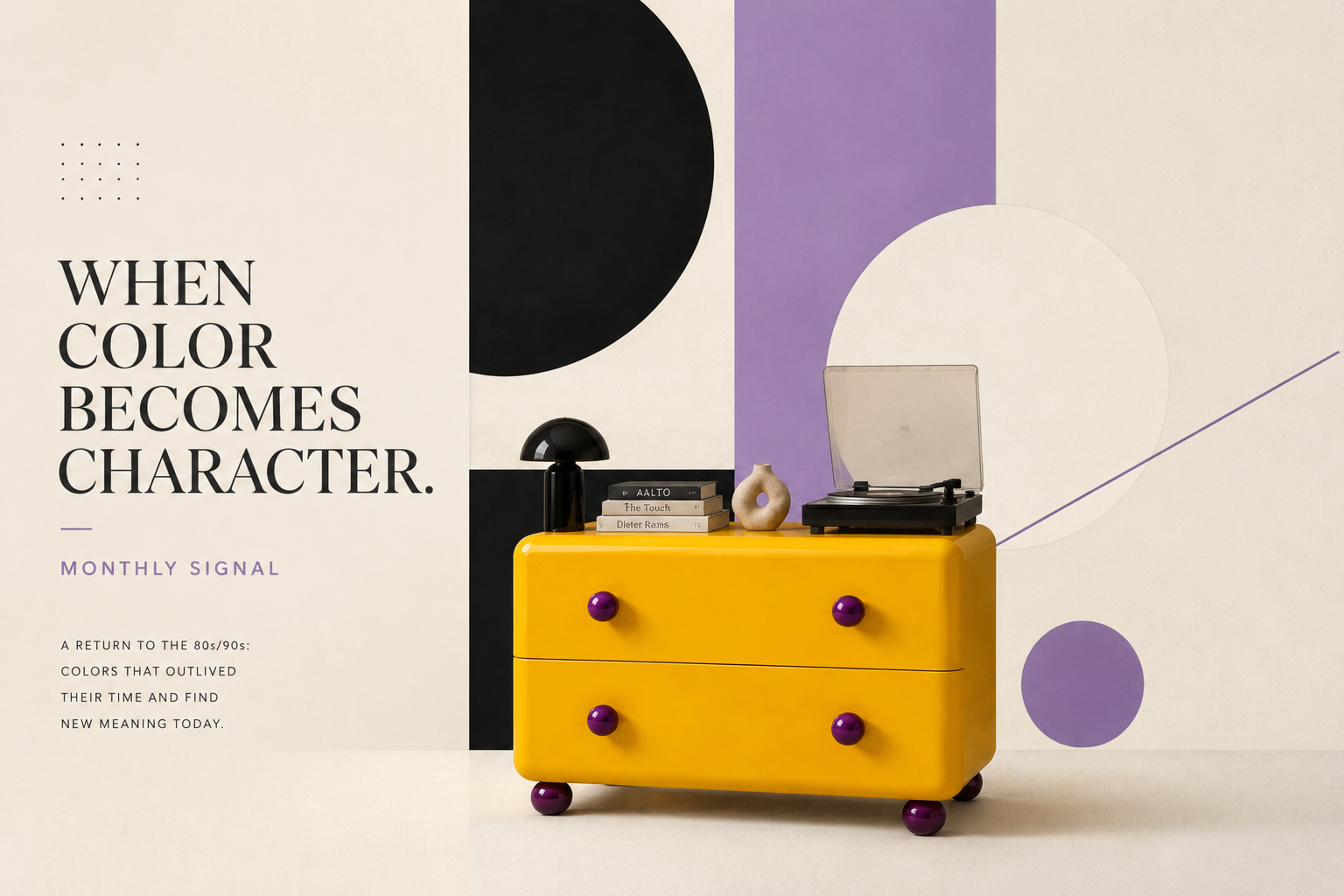
You walk into a flat. Everything is in its place. Smooth natural tones, perfectly coordinated wood, walls in a shade of greige, not a single stray object, no unnecessary visual noise.
It is aesthetically clean, photogenic and calming.
And yet after a few minutes a feeling sets in that more and more people have been experiencing in recent years — a quiet, almost imperceptible exhaustion from perfection.
A fatigue with spaces that look more like a meticulously staged showroom or a catalogue photograph than a place where life is actually lived, breathed and created.
It is precisely from this counter-pressure that today's fascination with the nineties is born.
Or more precisely: the return of their mood, energy and uncompromising individuality.
Why Now? The Psychology of Return
The reason we are looking back at the 80s and 90s today is not blind nostalgia.
We do not want to replicate the aesthetics of that era down to the last detail, nor relocate into the visual language of a world thirty years gone.
We are looking for something that quietly disappeared from our homes during the last decade of minimalist sprinting:
- a sense of warmth and human presence,
- material depth and tactility,
- natural imperfection with its own story,
- a memory inscribed into specific objects.
After a period of very clean and neutral interiors, the desire for a space with its own character is returning.
The current revival of warm terracotta, colourful bathrooms, open shelves filled with real books or expressive statement pieces is not a random whim of designers.
It is a natural response to an overly uniform minimalist diktat.
What Is Coming Back — and What We Leave in the Past
The nineties were full of courage, colour and playfulness. What do we gladly reclaim from them today?
- The statement solitaireA bold yellow sideboard, a rug with a graphic pattern or a deep blue armchair that commands immediate attention.
- Geometry and graphicsA play with shapes, sheen, strong line and typography.
- Tactile cultureCollections of books, records and objects that we do not hide behind closed doors, but let breathe as part of our personal world.
- Warm tones and natural texturesThe return of terracotta, fired clay, rougher fabrics and lush indoor greenery.
What stays in the past?
The notion of an interior as an untouchable time capsule is certainly not returning.
Neither are overcrowded spaces, cheap plastic chaos, cumbersome wall-to-wall furniture sets, nor complete retro ensembles where everything matches to the point of losing all personality.
2026: Not 90s Back, But 90s Translated
Today's design does not function as a slavish copy.
It functions as a memory translated into a contemporary architectural language.
The principle remains, but the context and the tools have changed.
Colour, courage, a personal world — often spontaneous and chaotic.
The same character, but with new elegance, space and refined detail.
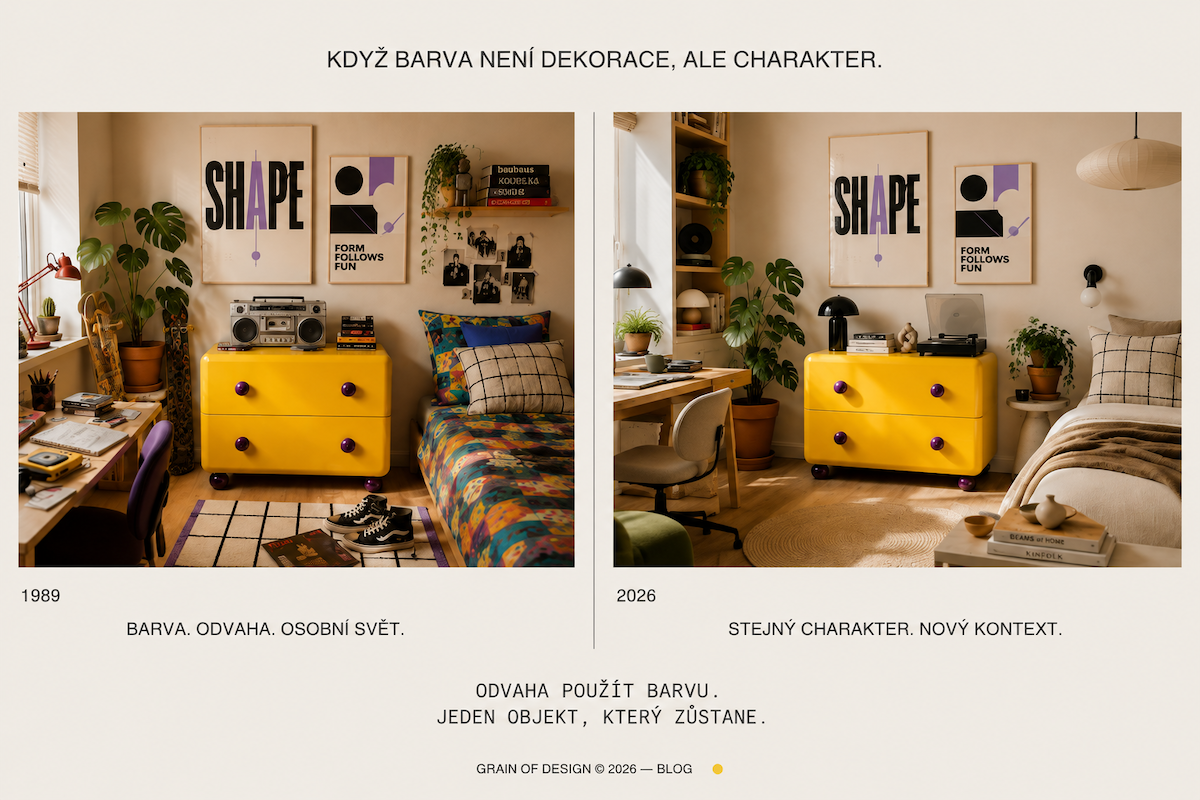
ᴳᴰ Visualisation created using generative AI · Concept and creative direction: Grain of Design
Technology changes, but human rituals remain.
We no longer pull out a plastic cassette player with tangled tape — we lower a gramophone needle onto vinyl instead.
In place of a random jumble of posters comes an archival typographic print in a fine frame.
Instead of plastic surfaces, we choose honest ceramics, glass and veneer.
An object no longer serves merely as a practical item or a soulless decoration — it becomes a carrier of character.
The Line Between Character and Clutter
This is where the key question of contemporary aesthetics lies:
Where exactly is the boundary between distinctive character and overwhelming clutter?
It is the most delicate part of creating a home.
- One terracotta element — a solitary plant pot, a hand-shaped vase or a terracotta tile — can anchor a space and bring warmth into it.
- An entire flat in terracotta, however, very quickly turns into a theatrical backdrop.
- One yellow cabinet in a neutral room works as a confident personal signature.
- Walls, sofa, lamps, accessories and vase in the same colour no longer carry character — they begin to cry for help.
The art lies in contrast and breathing room.
A bold element inspired by the nineties needs space, quiet and light around it in order to truly stand out.
Trends do not return as copies. Their principles return. 🟡
Should a Home Always Be Perfectly New — or Can It Grow Gradually Alongside Us?
Write to us via the Grain of Design contact form.