Prague is not a static document, but a living organism with its own inertia. Sometimes it is a harmonious symphony, other times a painful breakdown into pieces that we are now — decades later — trying to put back into one coherent logic.
The current Prague exhibition season offers two fascinating probes into how this city has thought — and how it lives.
DEVADE: Prague Drawn in Pastels
The nineties weren't a style. They were conditions.
The period between 1989 and 2004 in Prague resembled a wild laboratory. Architects suddenly had absolute freedom, investors were hungry for space and capital, but the planning system was still in its infancy.
The city was learning to function in a new reality — and sometimes it was more searching than planning.
Pankrác: An Unfinished Debate in the Skyline
Pankrác is one of the most visible proofs of that era's "self-searching." On a hilltop visible from much of Prague, capital met ambition — but without a clear script.
Someone wanted low blocks continuing the city's historic structure.
Someone else dreamed of sprawling parks.
Others wanted a "European Manhattan."
The result? Something in between.
A few towers, large gaps, and an uncertain structure. Pankrác is actually an urban debate that never ended — it simply froze into verticals that still provoke when seen from the Castle.
A Tip for You
If you want to understand why Prague looks the way it does, don't miss the DEVADE project.
The book DEVADE by Matěj Beránek and the collective has quickly become one of the most discussed titles about contemporary Prague architecture. The book is accompanied by an exhibition at CAMP presenting thirty buildings that shaped the city during the time it was learning to be free.
Spaceship Enterprise: When Architecture Breathes
While the nineties were about finding order in chaos, the brutalism of the Machoninovi couple was about absolute formal logic.
The exhibition Spaceship Enterprise at Gallery Prostora takes us aboard the Czechoslovak embassy in Berlin — a building that landed in 1978 like a spacecraft next to the Berlin Wall.
Design Without Compromise
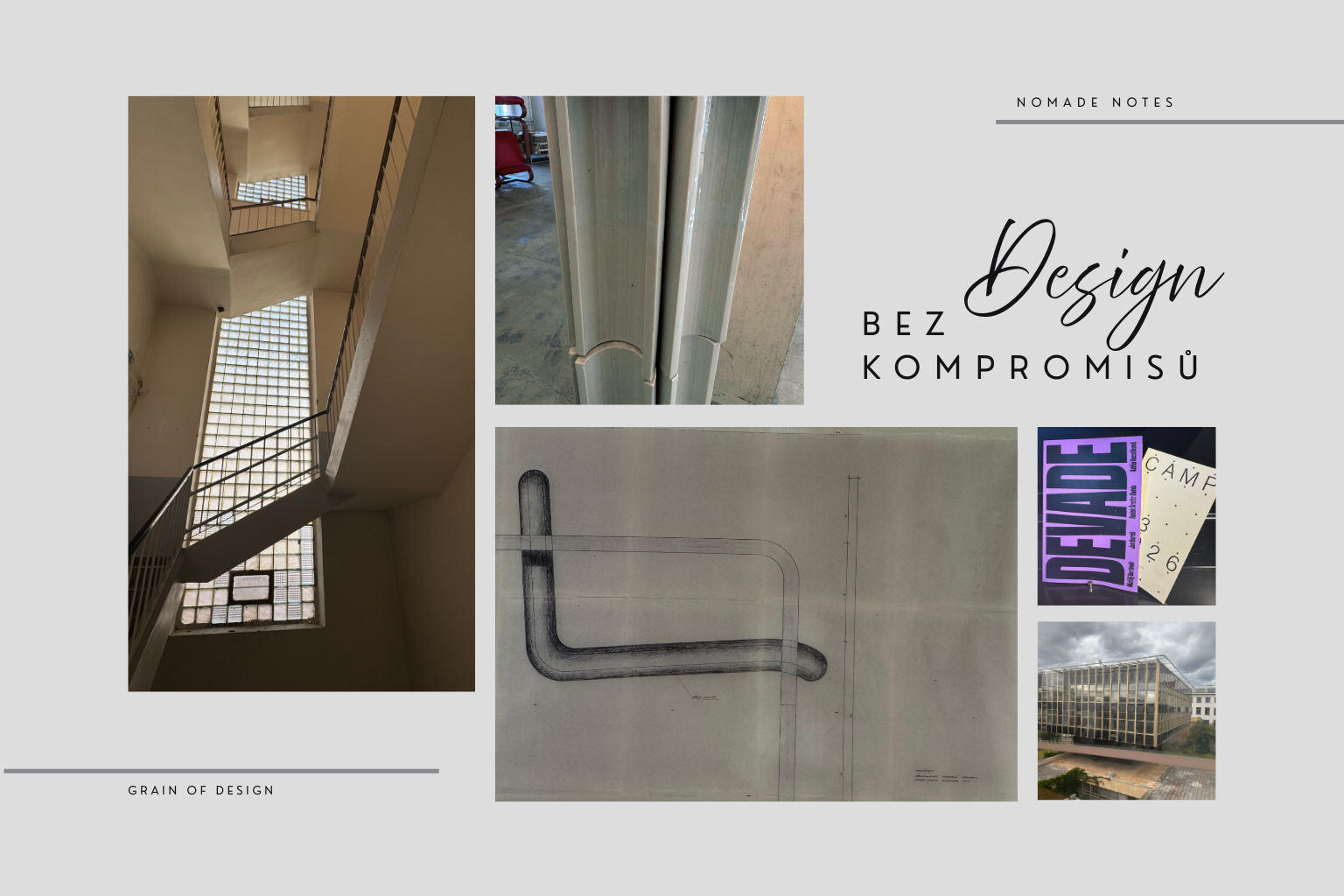
Entering the exhibition through a staircase flooded with light from a glass block wall defines the entire experience.
Here, architecture stops being a building and becomes a structure.
What fascinates us about the work of the Machoninovi even today?
Thinking with the hands
The archival drawings have a delicacy and precision that no CAD software can replace. It is a thought captured in process.
Material as emotion
The ceramic lamp tiles are heavy and solid, yet their glaze reflects light with incredible softness.
Proportion without aggression
A typical lamp — a simple cylinder made of modular segments. Tall and dominant, yet not aggressive. A quality that today's fast serial production often lacks.
Things were designed here in the opposite way from what we're used to today.
First the idea.
Then the material.
Then production.
No compromises.
Architecture Is Not Aesthetics — It Is a Trace
The architecture of the nineties and the brutalism of the seventies have one thing in common: they are traces of their time that cannot be erased.
We can read and understand them — or ignore them.
But the city remembers.
Looking at the Machoninovi drawings, one realizes a single thing: good architecture does not age. It only waits until we understand it again.
Where to Find These Traces Right Now
(until May 17, 2026)
Including guided tours
(until March 26, 2026)
"Good architecture does not age.
It only waits until we understand it again."
Which building from the "wild nineties" stirs the strongest emotions in you?
Write to us through the contact form.