There are places you set out to find. And then there are the better ones — the ones that appear along the way.
I hadn’t set out for Norbertov to look for a forgotten village in the middle of Prague. I was there for the architecture: a Functionalist villa, broad windows, a garden, a view across the city. A clarity that, almost a century on, still feels surprisingly contemporary.
But then I turned a corner.
And Prague disappeared.
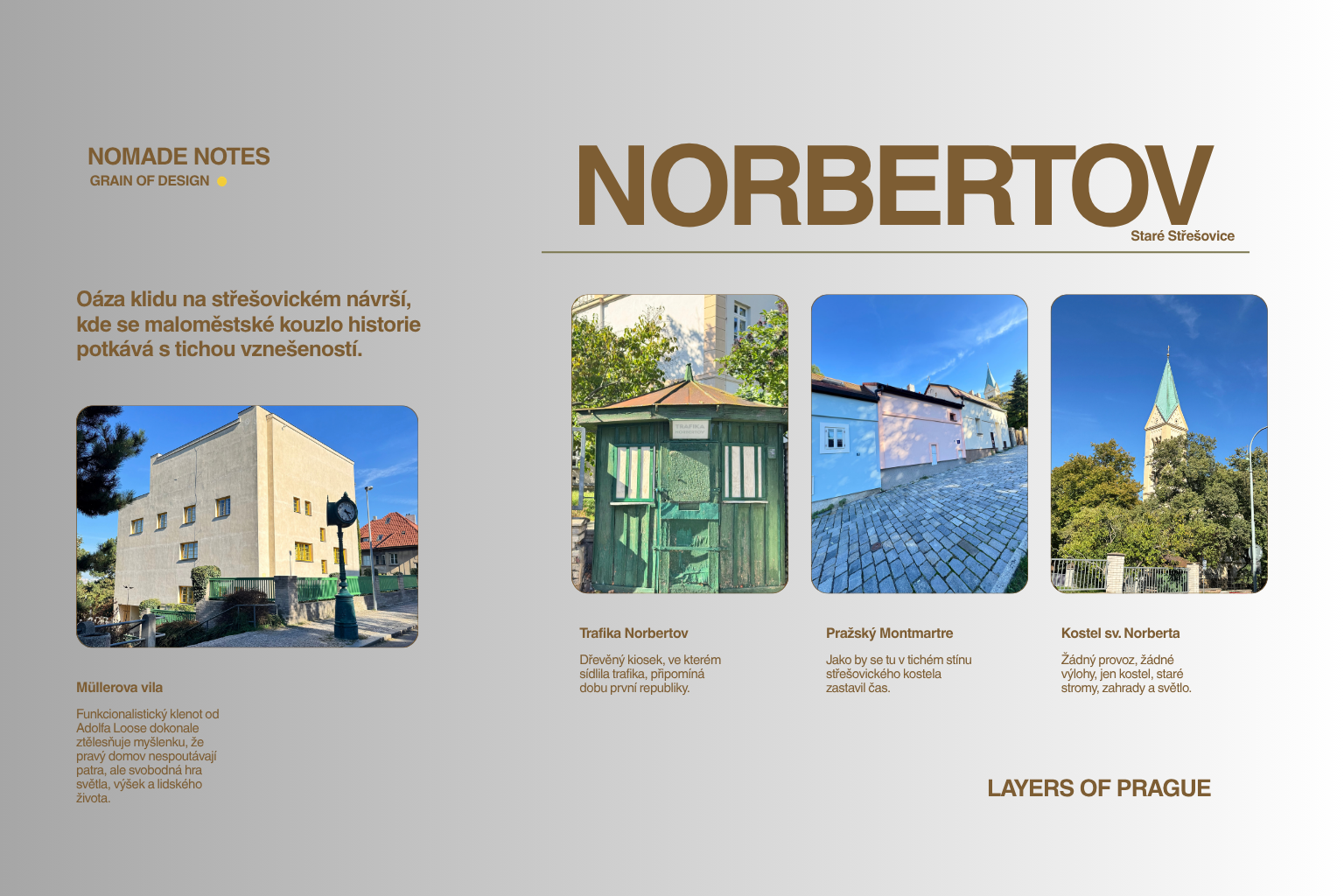
Suddenly there was no traffic and no city noise. Just a church tower among the treetops, cobblestones, low houses in soft blue, pink and cream, gardens, and a peculiar quiet in which you could hear the leaves rustle.
Twelve tram stops from home — and I felt as though I had travelled somewhere entirely different.
Prague Across Several Eras
That is what makes this part of Střešovice so fascinating: there is no single architectural layer here.
The old cottage-built streetscape recalls a time when Střešovice was not yet part of the metropolis. On the hill stands the Church of St Norbert, dating from the late 19th century. A few steps farther on, among the gardens, appears the radical architecture of the First Czechoslovak Republic — and the Müller Villa by Adolf Loos and Karel Lhota.
In just a few minutes on foot, you move from a village to Modernism without needing a transition between the two.
And, somehow, they do not clash.
Perhaps because they share something more important than style: human scale, gardens, the terrain and the space between the houses.
The Church That Once Stood Among Fields
Today, the Church of St Norbert seems as if it has always been here. But when it was built in 1890–1891 to a design by František Rožánek, the setting looked very different.
Back then, the hill held a church, a rectory and a sexton’s cottage, surrounded by fields and vineyards. The project was initiated by Zikmund Antonín Starý, Abbot of Strahov, and the dedication to St Norbert refers to the founder of the Premonstratensian order.
When I arrived, there was almost no one there.
I photographed the interior through the grille at the entrance, creating one more, unplanned geometric layer in front of the church nave. Beyond it lay a long red carpet, a black-and-white floor, arches and light coming in from the altar.
A perfect photograph, created by an obstacle.
The Kiosk That Refused to Leave
And then came Trafika Norbertov.
The small green wooden kiosk, squeezed between much larger buildings, feels almost absurd. As if someone had forgotten to come back and remove it when the city was modernised.
Thankfully.
Its peeling green paint, little shutters, timber and proportions have more character than many a perfectly designed contemporary urban installation.
It is not monumental. It is not grand.
It simply stands there.
And reminds us that a city’s memory is sometimes held not in its grand buildings, but in its smallest ones.
Prague’s Montmartre
A few steps farther, the street slopes away and a row of low houses comes into view.
Blue. Pink. Cream.
Red roofs, little windows, uneven cobblestones, and above them all, the tower of St Norbert.
“Prague’s Montmartre” is, of course, a slight exaggeration. But that is exactly how the place felt to me in that moment. Not because it resembles Paris, but because the city seemed to change its rhythm for a while.
History here is not on display.
People simply live in it.
And that very ordinariness may be the greatest luxury of the place.
The Neighbourhood We Nearly Lost
There is, though, an uncomfortable footnote to the romance.
Old Střešovice is not a perfectly preserved historic village. Part of its original urban fabric was demolished from the early 1980s onwards, and by the late 1980s there was a plan to clear the original buildings and replace them, among other things, with housing for diplomats. The political change of 1989 halted further demolition. The 1990s were not without their problems either — new, much bulkier buildings continued to disrupt the historic scale.
That is why today’s gaps, the unusual neighbours old and new, and the few surviving rows of small houses are more than a picturesque backdrop.
They are what remains of something that could have vanished altogether.
Nearby Střešovičky has been protected as a village conservation zone since 2005.
Walking those quiet streets today, it is hard to believe how easily their story might have been ended by a few decisions on paper.
And Then Comes Loos
Keep walking and the scale changes again.
Through the trees, the large, almost elemental mass of the Müller Villa appears.
Müller Villa — Prague City Museum
Adolf Loos and Karel Lhota designed it for František and Milada Müller between 1928 and 1930. Even getting it built was far from certain. The authorities objected to the height and worried that its unusually smooth façade would disrupt the surrounding villas. In April 1929, the city council rejected the building permit; it was granted only in June, after an appeal. The dispute became so well known that the contemporary press wrote of “Prague against Loos.”
Today, the idea that this house might have been considered a problem sounds almost comical.
From the street, the villa gives almost nothing away.
It is large, severe and closed off. Then you walk around it.
The garden rises in layers; greenery gradually swallows the architecture, with bold yellow window frames appearing through it. The fence is green. Ivy spills over the façade. A historic clock stands in front of the house.
Suddenly, the villa is no longer a white Functionalist cube.
It is part of the landscape.
The garden was not an afterthought, either — it was designed alongside the house.
And perhaps that is one of Norbertov’s loveliest lessons: clean architecture does not have to be sterile.
Sometimes you only have to let it age, grow over and live.
The House That Outlived Its Residents
The Müllers’ story is less light-hearted.
After 1948, the villa gradually ceased to be their home. František Müller died in 1951 from carbon monoxide poisoning in the boiler room; their only daughter, Eva, emigrated, and in 1959 the villa was finally expropriated. Milada Müller was left with two rooms and a bathroom; state institutions used the rest of the house.
Milada did much to ensure that the house’s original character would not be forgotten. She fought to save the villa until her death in 1968.
After 1989, the story turned. The villa came into the care of the city and the Prague City Museum. During the extensive restoration that began in 1998, conservators preserved not only its most striking features but also the original windows, doors, floors, furniture, stone, metal, glass, ceramics, wallpaper and even the original paint colours revealed by paint probes.
Perhaps that is why it does not feel like a reconstruction today.
It feels like a home.
Twelve Stops
In the end, what surprised me most about Norbertov was something very simple.
How little we sometimes know about the city we live in.
You can walk around Prague for years, thinking you have some idea of what lies beyond the next street. Then you step off a tram, turn a few corners and find a world you never knew existed.
Old houses.
A kiosk.
A church among the trees.
Functionalism.
Gardens.
And, above all, quiet.
Norbertov is not a place that needs a major attraction. Its greatest value lies in the coexistence of things that, according to the textbook, perhaps should not work together.
A village and a metropolis.
A church and Loos.
A pink house and a white Functionalist cube.
History and everyday life.
And between them, greenery slowly bringing it all together.
Perhaps that is why I felt as if I had left Prague for a few hours.
And yet I was only twelve tram stops from home.
NOMAD NOTES
Some places do not have to be far away.
Sometimes you only need to turn the corner in time.
Do you have a place you stumbled upon by accident — and have kept a little to yourself ever since?
Write to us through the Grain of Design contact form.