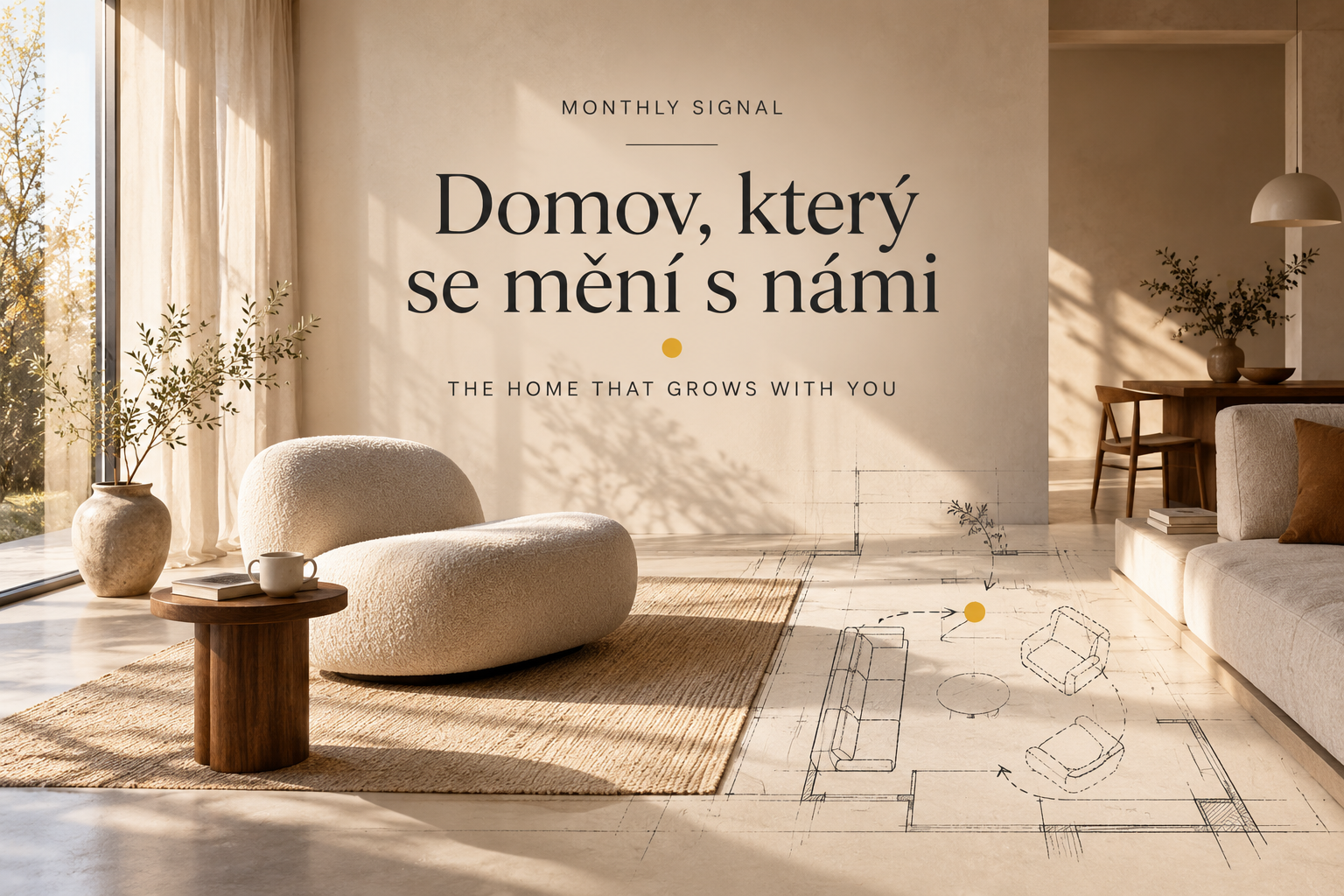
Sometimes we do not need a new home. We need to look at the one we have in a different way.
We design interiors as if our lives were going to stay the same. We carefully assign a function to every room, choose bespoke furniture and look for the ideal layout. But life is not a floor plan. Our work, relationships, interests and need for privacy change. What if the best interior is not the one that is perfectly finished, but the one that lets us change?
Perhaps the greatest luxury is not an interior where everything has been perfectly resolved. Perhaps it is a space that lets us change our minds.
Life Is Not a Floor Plan
We often admire photographs of perfectly furnished rooms where every object has its exact place. But a photograph captures just one moment. A real home needs to work a year from now, five years from now and in a different stage of life.
Children grow, we change jobs and discover new hobbies. Sometimes we need more company; at other times, more privacy. An interior designed as a definitive composition may not know how to respond to those changes. When life changes, the space should be able to change too.
A Home as a Living Organism
Adaptable living is not just about a flexible floor plan. It is about a space’s ability to adjust to different needs without forcing us to start from scratch each time.
Change happens on several levels:
- Everyday – the dining table becomes a place to make things in the evening.
- Seasonal – a reading nook appears in winter; in summer, the space opens up more.
- Life-stage – a child’s room gradually becomes a student’s room or a home office.
The smaller our space, the more important its ability to offer different possibilities can become. A new job, a new hobby, a need for privacy, rest or creativity – an interior should not make these changes harder. It should make room for them.
First, Let’s Change Our Perspective
Adaptable living does not have to mean expensive transformable furniture. Many changes require neither renovation nor new equipment. Sometimes it is enough to move a table closer to the window, turn the sofa in a different direction, adjust the lighting or make space for something we are enjoying right now.
The examples are simple and everyday:
- Move an armchair to the window, add a light and a small side table – and an ordinary spot becomes a personal reading nook.
- A freestanding bookcase, safely secured against tipping, can separate a work zone from the room’s relaxation area.
- Changing the direction of a table, adjusting the lighting and reorganising the surrounding space can create a place to work without needing a separate office.
- An empty corner without a clear purpose can make room for drawing, music or crafts.
Sometimes the biggest transformation does not begin with a new purchase, but with a new way of seeing.
Design That Does Not Prescribe How We Live
This is where furniture comes in. Not a catalogue of clever mechanisms, but principles that open up a space:
- Modularity – elements that can be rearranged, expanded or used on their own.
- Mobility – lightweight furniture, tables and storage that make it possible to change the layout.
- Multiple uses – a bench for sitting and setting things down, a table for both work and making things.
- Neutral function – furniture without a single prescribed way of being used.
Is the best piece of furniture really the one that can do ten things? Or is it the one that lets us decide what we need from it right now?
Overly complicated mechanisms can actually be less practical than a simple solution. Proportion, weight, mobility and the ability to create a new layout matter – even without physically transforming the furniture.
We Also Need Something That Stays
Adaptability does not mean constant change. A home needs stability. We have favourite places, objects with personal histories and everyday rituals. They are what create a sense of security and belonging.
Not everyone wants to, or can, change their interior regularly. A good adaptable interior does not force us to change. It simply makes change possible.
Stability gives us a sense of home. Change gives us freedom. Good design should make room for both.
Space for Our Future Selves
When furnishing a home, we often start from the way we live today. But what if, in a few years, we start working from home? Discover a new interest? Need more quiet? Or find that our physical needs have changed?
This does not mean predicting the future. It means leaving room for it – with wide enough walkways, suitable work-surface heights, adaptable fittings and furniture that can be moved without major intervention.
Not as a technical checklist, but as a way of designing with care.
The best design does not need to know our future. It only needs not to stand in its way.
A Home Is Not a Finished Project
Perhaps we have come to think that a well-designed interior is one where everything has its exact place. But a home is not an exhibition installation. We live in it, change our habits, discover new interests and sometimes need very different things than we did a few years ago.
A good interior does not have to be ready for every change. But it should let us make one.
A home is not a finished product. It is a process. And flexibility – a space’s ability to grow with us – can extend its life precisely because we do not have to start over each time.
Coming Soon at Grain of Design
Life is Design
Sometimes all it takes is a change in perspective. Not a whole new interior.
Not every change at home needs to begin with a renovation. Sometimes all we need is a fresh perspective on the space we live in and a few well-considered decisions.
That idea is at the heart of Life is Design – a new service in development at Grain of Design.
It is for people who want to take their home further but do not need a major interior-design project. It might be a newly purchased flat, one room, a work corner or a home where everything seems fine – and yet something is missing.
The goal is not to change everything. It is to discover the possibilities already present in a space and turn them into concrete, meaningful solutions.
Life is Design
Small changes. A different perspective.
If your home could make one small change with you today, what would it be?
Write to us through the Grain of Design contact form.
We do not have to only think about our space. We can play with it, too.
Grain of Design Workshops