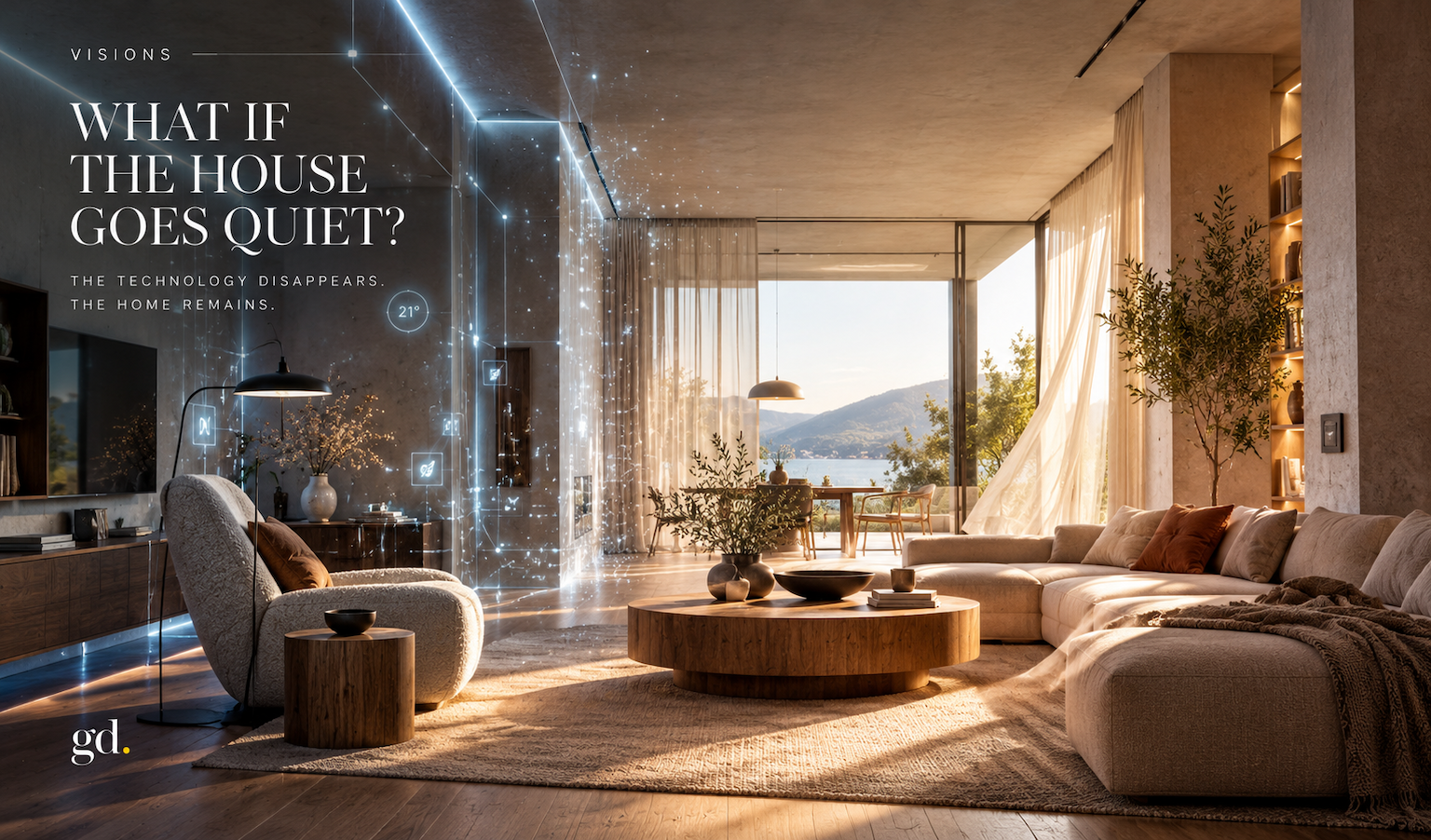
A good interior of the future is not one that stops working without technology. It is one that simply changes.
It is all too easy to be swept up in the fascination with automation. We create spaces threaded with data cabling, equipped with sensors, intelligent controls and devices that, in some cases, depend on remote servers, a constant internet connection and cloud services.
The house learns our habits. It regulates the temperature, adjusts the lighting, controls the shading and alerts us to the slightest deviation from its programmed routine.
But what happens when the power goes out for several hours? When the internet stops working, a cloud service fails, or the smart-home control unit decides to call it a day on a Sunday evening?
And what if the manufacturer simply stops supporting a device that is still perfectly functional in every physical sense?
These are not dystopian scenarios. They are ordinary technical situations.
Interior design routinely considers comfort, ergonomics, acoustics, light and colour psychology. We pay far less attention to the resilience of an interior as part of psychological comfort.
Yet simply knowing what to do when something breaks or a service goes down has a profound effect on how we relate to a space.
We designed a smart home. But did we also design a home for the moment when it cannot be smart?
We do not need a basement full of canned food or a generator the size of a car. We only need to make sure that the basic workings of a home do not depend on a single chain of technological dependencies.
1. When comfort becomes dependency
In designing contemporary interiors, we have grown accustomed to handing some of our control to invisible digital managers.
Automatic blinds wake us in the morning, intelligent controls adjust the temperature and we sometimes use an app or a biometric scanner to open the door.
This system can bring genuine convenience. As long as it works.
The problem is not technology itself, but the moment a useful assistant becomes the only way to access a basic function.
Where exactly is the line between comfort and loss of control?
If an app that stops working leaves us unable to operate the shading, change the temperature or switch on a bedroom light, has the interior become our master rather than our servant?
True autonomy at home means that a house remains welcoming to people even when its electronic controls stop working.
And this is where we can return to one seemingly ordinary household situation.
When the washing machine develops anxiety.
Today's appliances are equipped with highly sensitive sensors. They can detect an unevenly distributed load, insufficient water supply or a minor operational irregularity.
That is useful. Technology protects us from breakdowns and unnecessary damage.
Sometimes, though, you get the feeling your washing machine needs a psychologist more than a service technician.
A tiny irregularity is all it takes for another warning to appear on the display.
Give it a little longer and we might read:
“Not doing laundry today. I’m not feeling up to it.”
Of course, I am exaggerating. But these small absurd moments make it easy to see how our relationship with home technology is changing.
A smart home should know not only how to communicate and anticipate, but also how to step back and leave control with the person.
Truly intelligent technology must also know when to be quiet.
2. THE SECOND PATH™ — The Second Path
We could introduce a simple principle into design practice:
THE SECOND PATH.
Where it makes sense, every essential household function should have a second way of working. It does not have to be equally convenient or equally powerful. But it must be usable.
This is a broader approach than simply preparing a home for a blackout.
A second path can be useful during an everyday fault, an internet outage, maintenance, a change in technology, the end of software support or a simple wish to put the digital world aside for a while.
This is not design driven by fear.
It is design for continuity.
It is important to distinguish between different kinds of failure. A Wi-Fi outage is not the same as a loss of electricity. A mechanical light switch can preserve control when a smart hub fails, but on its own it will not help during a complete power outage.
A second path does not always mean a second device. Sometimes it is another way to control something, sometimes an independent source, and sometimes the architectural solution itself.
How can THE SECOND PATH work in practice?
Light and orientation
Basic lighting should not depend exclusively on a mobile app or a central control system. Wherever it is technically possible, it makes sense to retain direct local controls.
For situations without power, it is worth considering safe rechargeable or battery-powered lights, especially along circulation routes.
Daylight is just as important. Well-oriented windows, skylights and a carefully considered layout make it possible to use an interior during the day without artificial lighting.
Heat and thermal comfort
A high-quality building envelope, appropriate glazing, effective shading and thermal mass can slow unwanted changes in indoor temperature.
Heavy masonry, concrete and stone can store heat and release it gradually. They do not, however, produce any new heat.
A thin layer of microcement is therefore not a backup heating source. What matters most is the thermal capacity of the structure beneath it.
In some homes, an independent heat source such as a suitably designed stove may also make sense. Such a solution must meet fire-safety, building and operating requirements, and it is not suitable for every situation.
Fresh air and indoor climate
Manually operable windows are an important alternative to automated ventilation, where the layout, outdoor air quality and character of the building allow it.
A considered placement of openings can support cross-ventilation or natural airflow through the stack effect.
At the same time, we need to think about safe window operation, fall protection and the ability to ventilate without an electric drive.
Doors, shading and furniture
Electronic locks should have a well-designed alternative means of access. It is especially important to ensure safe exit from the building if the system fails.
Automated shading can be complemented by manual controls, if the particular product and installation allow it.
Simple mechanical systems that need no motor, app or remote connection also have a place in furniture.
Sometimes the smartest detail is an ordinary handle.
Water, the kitchen and everyday essentials
In kitchens and bathrooms, too, it is worth distinguishing between ordinary mechanical functions and those that depend on electricity.
An electronically controlled tap, a pump or an automatic flushing system can change how we use a space during an outage. In some buildings, a power cut can even affect the water supply itself.
An offline design must therefore be based on the actual technical arrangements of a particular building, not on the assumption that all ordinary services will work automatically.
Controls everyone can use
A second path is not a real alternative if someone cannot reach it, recognise it or use it.
Manual controls also need to take children, older people and people with limited mobility or visual impairments into account.
A physical control, clear labelling and predictable behaviour can be more valuable in many situations than another feature in an app.
3. Weight, texture and light: when materials speak
When the displays, fans and speakers fall silent, qualities of a space that we may not pay much attention to in everyday use come to the foreground.
Acoustics. Natural light. Touch.
Suddenly we notice the grain of the wood, the texture of plaster, the coolness of stone or the softness of linen textiles far more intensely.
These are the moments when we see the value of a material approach that does not rely on technical effects.
This does not mean that natural materials automatically create better acoustics or a healthier environment. Every material has different physical properties, and using them well takes thoughtful design.
But they have another important quality: they offer direct sensory contact with a space.
Materials do not have to literally absorb our tension to give us a sense of grounding. Sometimes a surface with qualities we know well is enough.
A shadow slowly moving across an earthen plaster wall throughout the day can become the simplest kind of clock.
Textiles that soften the sound of footsteps. Solid wood that gains a patina over time. A stone windowsill warmed by the afternoon sun.
These are all qualities of a space that do not need an internet connection.
Architecture has its own natural intelligence: material, spatial and sensory.
And an interior built on these qualities does not need animated screens to feel alive.
4. OFFLINE PLAN — a new tool for designers
Alongside drawings for electrical installations, lighting, building services and furniture, we could also begin to create an OFFLINE PLAN.
Not as another complicated document, but as a simple, clear map of dependencies and alternative ways to use an interior.
Its purpose would be to answer three basic questions.
NORMAL MODE — Everyday operation
How does the space work when all technologies are available? Which systems use automation, and which depend on the internet, a central hub or a cloud service?
DEGRADED MODE — Limited operation
What happens when one part of a system stops working? For example, Wi-Fi, a smart hub, a particular sensor or a single automated function?
What can still be controlled locally, and which functions are limited?
OFFLINE MODE — Operation without digital infrastructure
How is the interior used without a connection, without central control or during a complete power outage?
This is where a design must distinguish what remains available during an internet outage from what genuinely works without electricity.
For systems with a backup battery, it is also important to know how long they can keep working.
Technology is not the only thing that matters; its lifespan does too
An Offline Plan should include another aspect that is easy to overlook when designing smart homes: future serviceability and technological independence.
What happens if the maker of a control unit no longer exists in ten years? Can a device be replaced without major work to the interior? Are controls, cable routes and service access documented and accessible?
Can basic functions be used without a cloud account?
And can individual parts of the system be replaced with products from another manufacturer?
Choosing devices with available technical documentation, long-term support and open or widely used communication standards can matter as much to the lifespan of an interior as choosing quality materials.
Because we usually design interiors to last far longer than the life cycle of a single app.
5. The silence test: does the second path really work?
One more thing should become part of the design process.
It is not enough to draw a second path. We have to check that it works.
Imagine a simple scenario.
It is evening. The internet is down. The home's central controls are unavailable.
Can the resident switch on the basic lighting? Open the door? Operate the shading? Find out which device needs servicing?
And if the power goes out as well, can they safely find a backup light and make their way out of the apartment?
Where suitable systems are in place, these situations can be tested when an interior is handed over, possibly in collaboration with a responsible technician or building manager.
There is no need to turn a home into a training centre.
It is enough for its residents to know what to expect.
The layout itself also plays a crucial role. Clear routes, safe edges, accessible controls and a logical furniture arrangement make it easier to find your way even in limited light.
A good interior should not have to keep explaining how to use it.
And the best backup solution is one a person can use intuitively even when tired, under stress or without a phone to hand.
Technology disappears. The home remains.
The future of interior design does not have to mean fewer technologies.
It could mean using them more thoughtfully.
Smart systems can help save energy, improve safety, make homes more accessible and support everyday comfort. It would be a shame to reject their potential.
But just as carefully as we design what they do, we should also design for their possible absence.
An interior is not a digital product that we simply stop using when support ends.
It is the environment in which we live.
So a good home is not measured by the number of apps needed to control it, but also by the sense of security it offers when every screen goes dark.
Sometimes our idea of comfort is fulfilled only when technology is no longer visible.
And what if one day it falls completely silent?
We should still know where to turn on the light, how to open the door and which way leads home.
Let us design homes that support us—in full operation and in silence.
True comfort lies not only in everything technology can do for us, but also in the freedom to decide when to let it rest.
The technology disappears. The home remains.
How much of the technology in your home do you really control—and how much of it controls you?
Write to us through the Grain of Design contact form.