Introduction
Just a few years ago, designing interiors was primarily a conversation about style. Minimalism, industrial, Japandi or Mid-century. Clients sought inspiration in catalogues and on social media and often asked:
"Which style is in right now?"
Today, that question is gradually shifting.
We are hearing something different more and more often:
"I want a home I'll still feel good in ten years from now."
That is a fundamental change.
The future of interior design will no longer be shaped by a new style. It will be shaped by the quality and depth of our decisions.
So what will homes designed for 2040 look like — and how will they work?
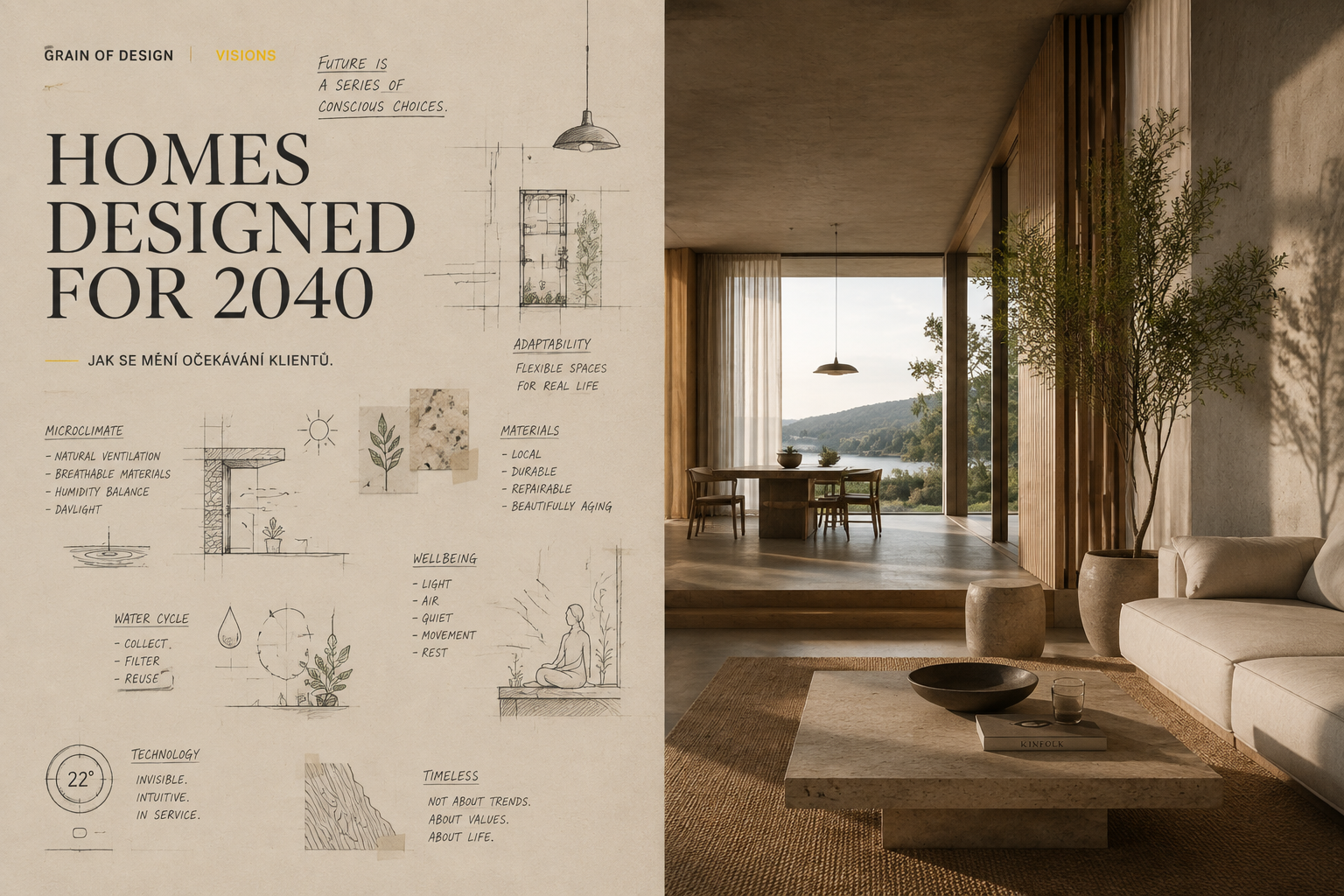
1. Sustainability and Climate Resilience Are No Longer a Bonus. They Are the Foundation.
Clients today think far more carefully about the origin of materials, their lifespan and the possibility of repair. Not because it is fashionable, but because they want to invest in things that make long-term sense.
By 2040, however, it will no longer be only about ecological origin. Climate resilience of interiors is becoming a key theme. Extreme temperature swings, scorching summers and prolonged droughts are changing the demands placed on how homes breathe and manage energy.
Local materials will take priority, because their origin and method of transport are beginning to matter just as much as the raw material itself.
Travertine, solid wood, natural plasters with thermal mass, recycled materials or quality steel are not merely an aesthetic choice. They are a decision for natural thermal stability, long lifespan and physical resilience that will hold up for many years to come.
2. Quiet Is Becoming the New Luxury.
After years of information overload, we are looking for something different at home — not more stimulation.
More light.
More space.
More silence.
Better air quality.
Better acoustics.
Luxury is no longer an abundance of decoration.
Luxury is the ability to breathe.
Quiet is no longer merely visual. It is becoming the overall quality of a space.
3. The Best Technology Is the Kind You Cannot See.
Artificial intelligence will be one of the finest assistants, not the star of the interior.
The smart home has matured and remains important, but the way we perceive it is changing.
An interior will no longer simply be beautiful.
It will respond to the person living in it.
Technology is not meant to be the main subject of an interior, but its natural component.
It should work quietly in the background without disturbing the aesthetic of the space.
Concealed lighting, unobtrusive controls, automation and intelligent ventilation are there to support everyday life — not to draw attention to themselves.
The result is a space that responds to a person's daily rhythm naturally and unobtrusively.
4. Materials Will Tell Stories.
Future interiors will not be built on impressive shapes.
Their character will be defined by materials.
Stone that develops a patina over time.
Wood that carries the marks of its history.
Glass that plays with light.
Steel that no longer feels cold, but elegant and calm.
Materials will cease to be mere surface finishes. They will become the primary bearers of atmosphere — repairable, recyclable and ageing gracefully. Patina will no longer be a flaw; it will become a quality.
Clients are beginning to ask not only:
"What does it look like?"
but also:
"Who made it and under what conditions?"
5. Flexibility Will Matter More Than Size (Across Generations Too).
The home of 2040 will not necessarily be larger.
It will be smarter.
It will be more thoughtfully designed.
Furniture will not simply stand in its place.
It will adapt.
Rooms will change their function more easily depending on the stage of life. A single space may serve during the day as a study, a place for gathering and a quiet corner for rest.
It is not about more square metres.
It is about more possibilities.
Perhaps it will become entirely normal for a single home to undergo several transformations throughout its life alongside the family living in it.
The interior will no longer end at the walls. The connection with the exterior, microclimate, garden or urban greenery will become a natural part of design thinking.
6. A Home That Supports Health.
By 2040, it will no longer be enough for an interior to look good.
Increasingly, it will be evaluated by how it affects sleep, concentration, recovery and the overall sense of safety.
Light that supports the circadian rhythm.
Materials that do not burden air quality.
Spaces that allow both movement and retreat into privacy.
Design will become less a question of impression and more one of long-term impact on the person living there.
Healthy Microclimate and Smart Water Management
The quality of life within an interior will increasingly depend on how well the space cares for our bodies and the surrounding environment.
Future homes will be built around a healthy microclimate — natural airflow, humidity regulation through natural materials, and lighting that supports the human body's natural biorhythm.
Smart water management will be equally important. Water will cease to be something we simply use and drain away. It will become part of a considered cycle.
Grey water from sinks and showers can, after filtration, serve for flushing or irrigation. Rainwater can become not only a practical resource, but also an aesthetic element of interior atriums or gardens. Drinking water filtration will be unobtrusively integrated directly into the heart of the kitchen.
Just as we think about the quality of light today, we will think just as naturally about the quality of water.
Conclusion
The homes of the future will not be defined by extravagant shapes or short-lived trends.
They will emerge from considered decisions that will stand the test of many years.
They will be quieter.
More natural.
More resilient.
And perhaps that is precisely why they will feel timeless.
Grain Reflection
Perhaps 2040 will not differ in what our homes look like.
Perhaps it will differ in why we chose what we chose.
A good interior does not begin with the selection of furniture.
It begins with the question of what kind of life we truly want to live within our walls.
2040 may not be a revolution.
It may simply be the logical continuation of the decisions we are already making today.
Every material, every piece of furniture and every window oriented towards the light is a small choice about how we want to live.
And it is from these small choices that homes are built — homes that stand the test of time.