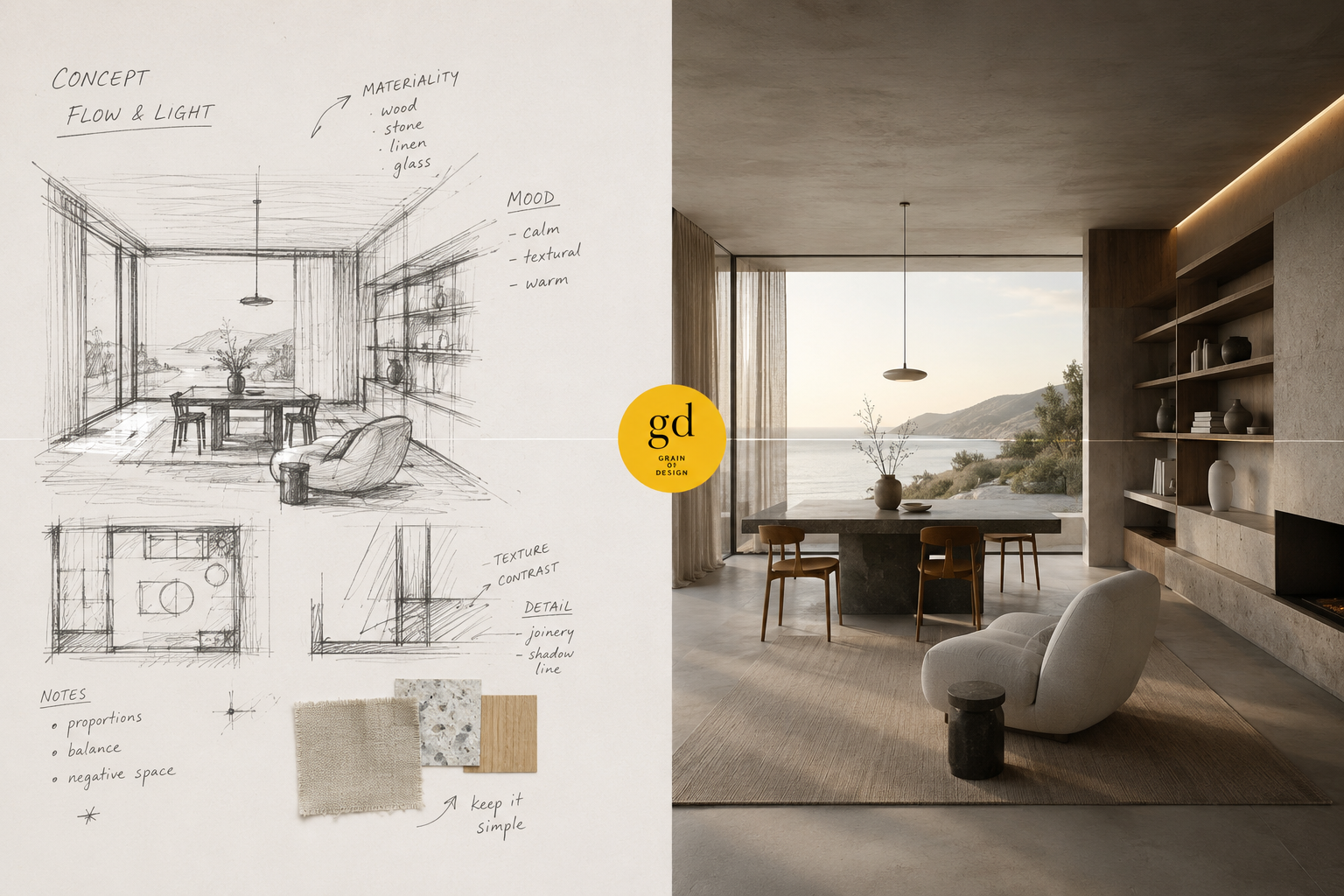
AI is not my designer. It's my sketchbook.
When I started designing interiors years ago, every new idea meant an enormous amount of invested energy. One direction, one coherent thought, hours of modelling, renders and sleepless nights.
And with that came fear.
What if the idea isn't good? Do I even have the energy to try a second option?
Today I can visually test ten different directions in a single afternoon. And paradoxically, that's exactly what made me trust my own intuition far more.
There are two tedious extremes circling around artificial intelligence in the creative industry today.
The first claims that "AI will save everything and designers will have nothing to eat."
The second hysterically warns that "AI will destroy creativity."
But the reality in top studios, where there is constant pressure on quality, time and originality, is far more pragmatic – and actually incredibly liberating.
1. Experimentation stopped being expensive
Twenty years ago, it was a huge advantage to be able to draw with perfect craftsmanship or to masterfully operate 3D software.
Today that is no longer an advantage in itself.
Technical execution has become a commodity.
AI is dramatically changing how moodboards, research, material directions, and even texts and client presentations are created.
AI has made experimentation cheap.
It has become a partner for sketching and gives designers the courage to take risks.
Not because every idea generated by an algorithm is good.
But because it is no longer so costly to find out that it isn't.
A few years ago I would have spent several evenings on one complicated concept, and I might not even have attempted a different, bolder direction because I simply wouldn't have had the mental capacity left for it.
Today, the process of rejecting dead ends takes minutes, not days.
2. The designer as editor
The hardest part isn't creating — it's choosing.
As AI becomes capable of churning out dozens of photorealistic designs in an hour, the role of the author is fundamentally changing.
The designer is becoming an editor.
This transformation is a topic being discussed intensively today even in major global architecture firms. There, AI doesn't function as a replacement for humans, but as a hyper-fast assistant that tests variations.
Because the hardest part of the creative process is no longer creating an image.
The hardest part is looking at that flood of possibilities, applying your own eye, taste and experience, and saying:
"This one. This one has soul and is worth developing further."
AI can instantly generate an aesthetically pleasing image.
But it cannot recognise which idea truly matters to the person who will actually live in that space.
The decisive, final word will always belong to the author, not the algorithm.
3. Uniformity of imagination
When everyone types the same prompts.
So where does the real risk of mass AI adoption in design actually lie?
Surprisingly, it isn't the uniformity of the interiors themselves, but the uniformity of our own imagination.
If all designers use the same generative tools, feed them similar prompts, and thoughtlessly copy aesthetic trends from Instagram, the result will be nothing but a polished, perfectly rendered average.
Machines will start churning out an endless amount of visual noise that looks great on a screen but lacks any deeper concept.
The true value of a designer today is their own point of view.
How we look at the world, how we interpret human emotion, history and the context of a place.
No AI can give us that.
Conclusion
More paper for our own signature.
There will soon be millions of images and visualizations online, and it will become increasingly difficult to recognise a specific author by them.
Yet good, strong ideas will remain just as rare in the human world.
Technology doesn't save me from thinking. AI only saves me time between two thoughts.
As a designer, I won't let an algorithm design an entire project from floor to ceiling.
I use it to instantly test the limits of what's possible and to push my own concept further.
AI didn't take away my signature. It just gave me an endless amount of paper to draw on.