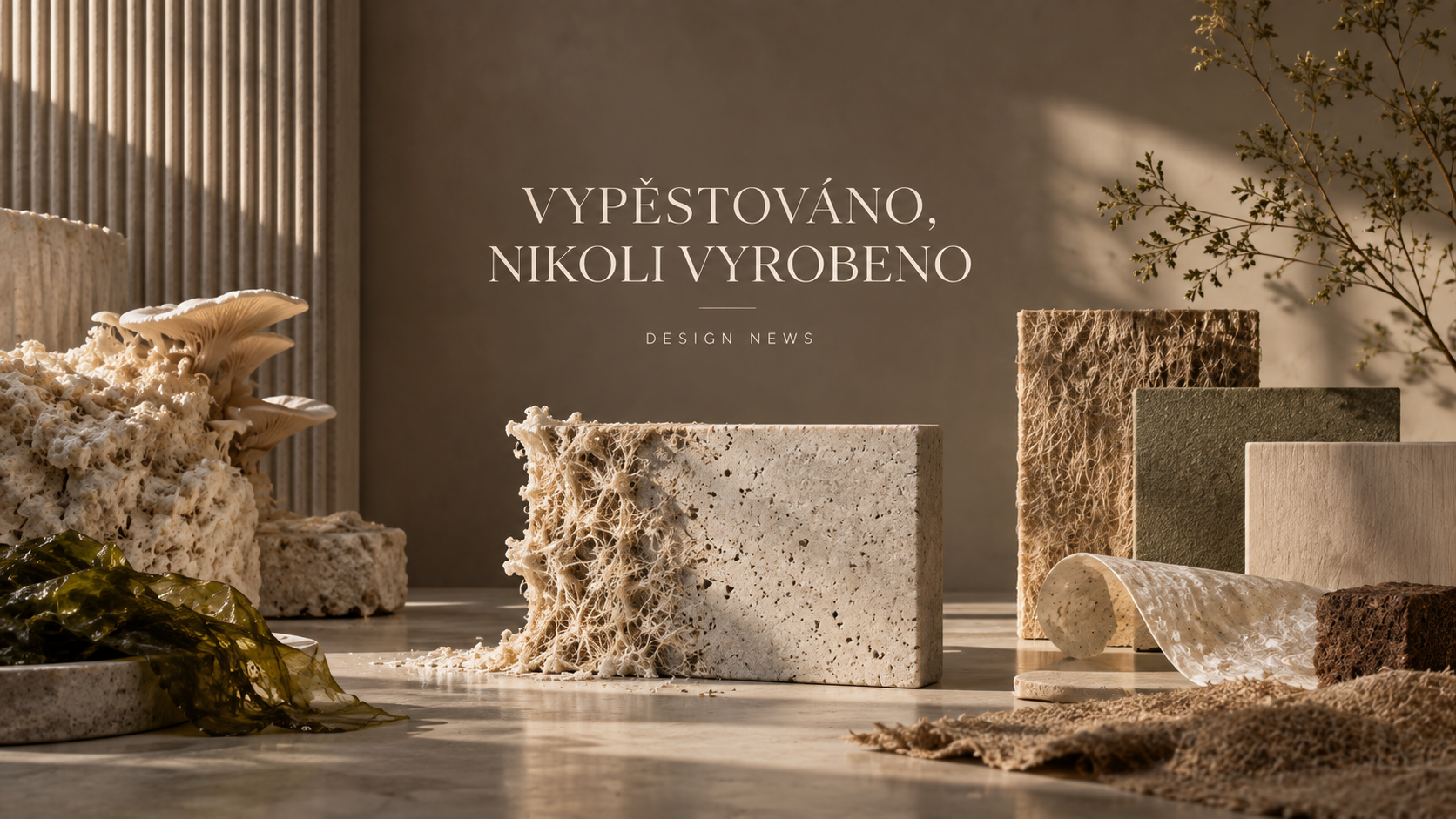
Material innovation today is not only about finding new raw materials. The very way we think about materials is changing — how they come into being, what they can do during their life, and what happens to them afterwards.
Bacteria, mycelium, algae and waste fibres will not replace the materials on which contemporary architecture currently depends. But they point towards a different direction: instead of linear production, a system in which a material can become part of another cycle.
This is not another “green trend”. It is a question that will become increasingly important for design: do we always have to make a material — or can we learn to create the conditions for it to come into being differently?
For centuries, we have primarily mined, melted, fired, pressed and cut materials. We took a raw substance, added a great deal of energy and forced it to become something else.
Now a new verb is entering the vocabulary of design:
to grow.
Bacteria can bind mineral particles. Mycelium grows through agricultural residues and forms light, strong structures. Cellulose becomes acoustic panels. Seaweed appears in lighting and surfaces. Waste textiles return to buildings as insulation.
This is not only about finding a replacement for plastic or concrete.
The interesting question is no longer only what we make a material from, but which process we allow it to emerge through.
And that may be a much more fundamental change than it first appears.
1. The Tile Bacteria Help Grow
One of the most convincing examples is Mimmik Tile, a mineral tile developed by Biomason and now produced at industrial scale.
Its principle is based on biomineralisation. During production, microorganisms support the formation of calcium carbonate crystals, which gradually bind individual aggregate grains together. After approximately forty hours, a continuous mineral structure is formed. The bacteria do not remain “alive in the floor” — they do their work during production, leaving behind a stable inorganic material.
Unlike ceramics, the process does not require a firing kiln; unlike conventional cement, it avoids the high-temperature production of Portland clinker. Biomason derives the principle from the way nature creates corals and other calcium-carbonate structures.
And it is no longer only a laboratory sample. Mimmik is used as an interior floor; projects include Helix Lab in Kalundborg, Denmark, the largest installation of this technology to date, as well as further office projects in the Netherlands and London. The current product is intended primarily for interiors, while further testing of its long-term properties continues.
That is what makes it more interesting than the bacteria themselves.
The material stopped being an experiment in a glass and someone began walking on it.
2. Mycelium: The Fungus as a Small Factory
Mycelium — the network of fungal roots — is one of the best-known representatives of the new generation of grown materials.
The principle is surprisingly simple. Mycelium grows through an organic substrate, such as agricultural by-products, and connects it with its fibres into a compact structure. Once the desired shape is reached, growth is stopped through drying or heat treatment.
The result does not have to be another decorative “eco tile”.
The Italian company Mogu already produces commercial acoustic panels made from mycelium and upcycled textile waste. According to technical documentation, variants with a B-s2,d0 fire classification also exist. This points to something important: biobased materials are beginning to be assessed by the same performance criteria as conventional interior products.
A different direction is shown by the London studio Phyta Biodesign. Its Apia system uses mycelium panels as part of habitat structures for solitary bees. Here the material is not merely a surface for humans — it becomes part of an infrastructure for other species. The project received a bronze medal at the 2024 RHS Chelsea Flower Show.
That pushes the question even further:
Does a facade have to be designed only for us?
3. Algae: A Material We Do Not Have to Grow in a Field
Seaweed is another fascinating raw material. It does not require arable land, and some species grow quickly in marine environments. It is not yet a universal construction material, however, and many applications remain at the stage of research and product experimentation.
That is precisely why designer India Iles’s Kelp + Lamp project from the Royal College of Art is interesting.
Iles works with Scottish kelp as a visible, aesthetic material, not as an ecological substitute that needs to be hidden.
In the lighting collection, she combines it with birch plywood, colours it and works with its translucency.
It is a small project, but it contains an important idea.
A new material becomes genuinely interesting for design when we do not choose it despite its appearance, but precisely because of it.
4. Cellulose: An Old Material in a New Role
Not every innovation has to grow in a bioreactor.
We have used cellulose for centuries, but new production processes allow it to take on functions that were often previously performed by synthetic materials.
The Swedish company BAUX, in collaboration with the studio Form Us With Love, developed Acoustic Pulp — acoustic panels made from a mixture of spruce and pine cellulose and wheat bran. The manufacturer describes them as 100% biobased, recyclable and biodegradable; the panels also perform the practical function of sound absorption.
This is where biomaterial becomes genuinely interesting for an interior designer.
Not as decoration.
As a building layer that does something.
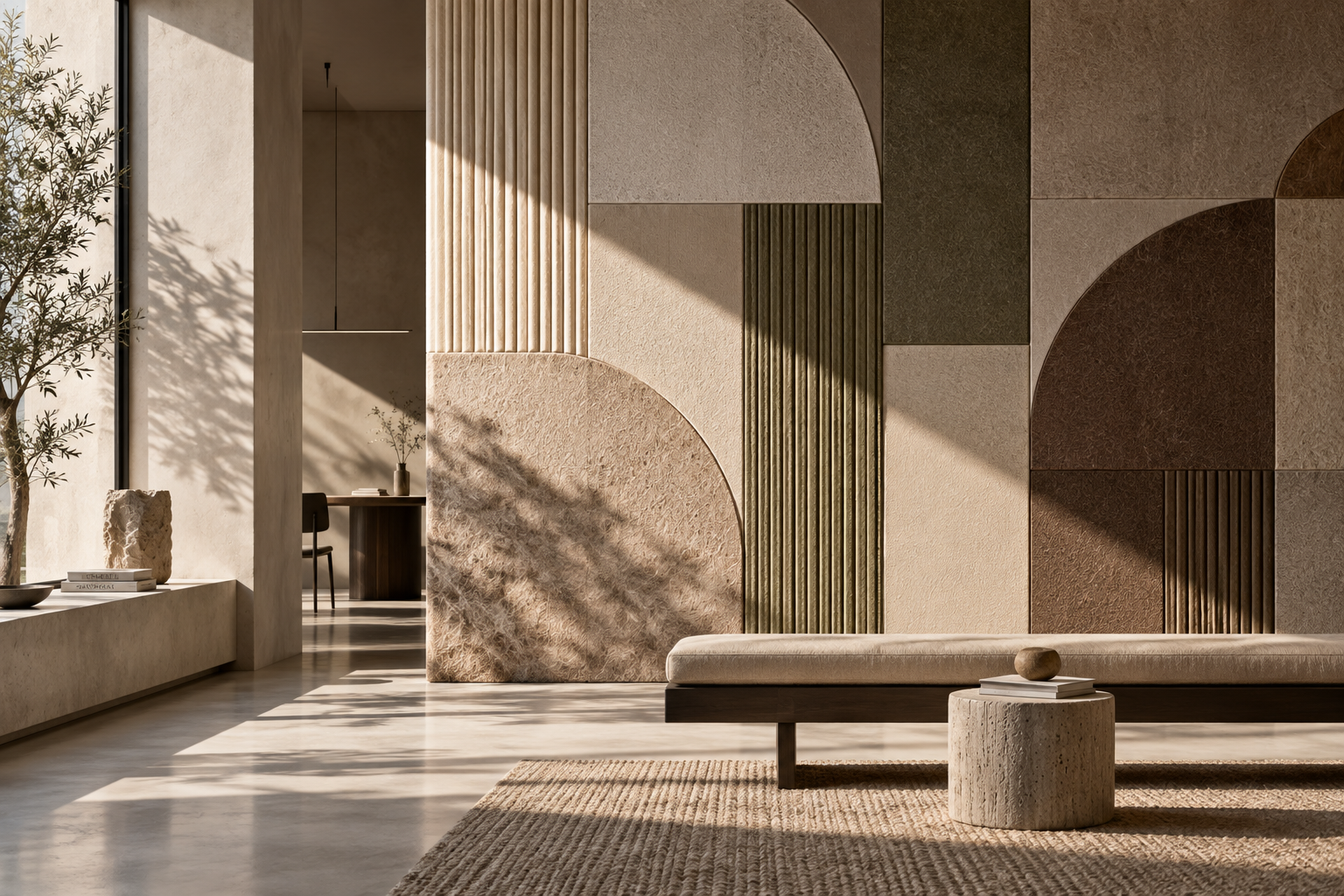
ᴳᴰ Visualisation created using generative AI · Concept and creative direction: Grain of Design
5. An Old T-shirt in the Wall
The second great material revolution may not be biological at all.
It may consist in finally realising how much material we already have around us.
The Danish company Insutex produces TexBatt 37 Bio, thermal and acoustic insulation made primarily from recycled textile fibres, especially cotton and wool. The product is intended for partitions, ceilings and timber structures; the manufacturer states a thermal conductivity of λ 0.037 W/m·K, low A+ VOC emissions and environmental data documented by an EPD.
In this case, the technology itself is not revolutionary.
What is revolutionary is the change in perspective:
old clothes do not have to be waste. They can be a reservoir of fibres.
This takes us from grown materials towards the broader principle of circular production:
waste → raw material → functional material → another life.
6. When Orange Waste Becomes a Surface
The same logic can be applied to agricultural by-products.
The Italian company Ohoskin uses by-products from Sicilian oranges and prickly pears in a material designed as an alternative to leather.
The material is intended for furniture, automotive and other interior applications.
But it is also a good example of why we should be cautious with the word “natural”.
Ohoskin is not dried orange peel. Plant-based components are combined with bio-based or bio-attributed polymers so that the finished material gains the necessary strength, durability and processability.
And hybrid materials like this remind us of something important:
the biological origin of one component does not automatically mean that a product is biodegradable or straightforward to recycle.
The future of materials therefore cannot be judged by a single marketing label.
7. Mulberry: An Innovation That Is Actually Very Old
Then there are materials for which we do not need any new technology.
We only need to notice them again.
The inner layer of mulberry bark has been processed into fibrous materials and paper in different cultures for centuries. Contemporary design is making use of this principle in interiors once more.
The Thai studio Ango, for example, uses mulberry bark fibres for handmade lighting diffusers. Branches are harvested, the inner bark is separated, boiled and hand-pulped; the resulting fibre clusters are then stitched onto the supporting structure of the light.
Elsewhere, mulberry bark is used directly as a wall surface. Contemporary commercial wallcoverings use hand-processed and dyed sheets of bark, whose natural variations in pattern are not a flaw but part of the final appearance.
That may be one of the most beautiful lessons of the entire subject.
The material of the future does not have to be new. Sometimes it can be very old — simply used in a new way.
8. Even River Mud Can Have a Second Life
At the opposite end of the spectrum is the work of British ceramicist Neve Beill.
She experiments with local clays gathered around London and from the banks of the Thames, and with glazes made from materials we would normally overlook: ash, fragments of glass found in the river or even cigarette ash.
This is not an industrial solution to the problem of construction waste. It is material research on a small scale.
But experiments like these ask a very good question:
How many raw materials do we call waste simply because we have not yet designed another use for them?
“Bio” Is Not Enough
Mycelium, algae, bacteria and orange peel look excellent in a headline. Biological origin alone, however, says surprisingly little about a material’s real environmental impact.
We need to know the whole story.
How much energy did production consume? Where does the raw material come from? Does the product contain a synthetic binder? How long will it last? Can it be repaired? Can its layers be separated? Can the product be reused or recycled? And what will actually happen to it at the end of its life?
That is why the material passport will become increasingly important for designers.
This is no longer just a beautiful concept. The European Union is gradually introducing the Digital Product Passport, which is intended to make machine-readable information about the composition, origin, environmental properties and end of life of products available. The DPP registry was launched on 20 July 2026, and the system is expected to expand progressively to textiles, furniture and construction products. The revised European Construction Products Regulation also introduces environmental characteristics based on LCA and its own digital passport system for construction products.
For an architect or designer, this could mean a fundamental change.
Alongside colour, dimensions, price and fire classification, one question may eventually become a completely ordinary part of a specification:
What will happen to this material in twenty years?
The Material That Knows What It Wants to Be
Perhaps we have spent too long imposing our idea of perfection on materials.
We made wood uniform. We polished stone. We replaced natural fibres with synthetics because they were more regular. We set up production so that thousands of perfectly identical pieces would come out the other end.
The new generation of material design offers a different approach.
It does not ask only what we can make from a material.
It also asks what the material can do by itself.
Mycelium can grow through things. Bacteria can mineralise. Cellulose can create a light fibrous structure. Kelp works with light. Textile fibres can continue to insulate even when nobody wants to wear them anymore. Bark can remain bark.
Perhaps the problem is not that we need ever more new materials.
Perhaps we need a new way of thinking about how they come into being.
The design of the future may not be about inventing ever more things. It may be about inventing better ways of how things come into being, how long they remain and what happens to them afterwards.
The future of design may not be about greater control over material.
Perhaps it will be about finally learning to listen to it.
If you knew the whole story of a material — where it came from, how it came into being and where it will go next — would it change your choice?
Write to us through the Grain of Design contact form.