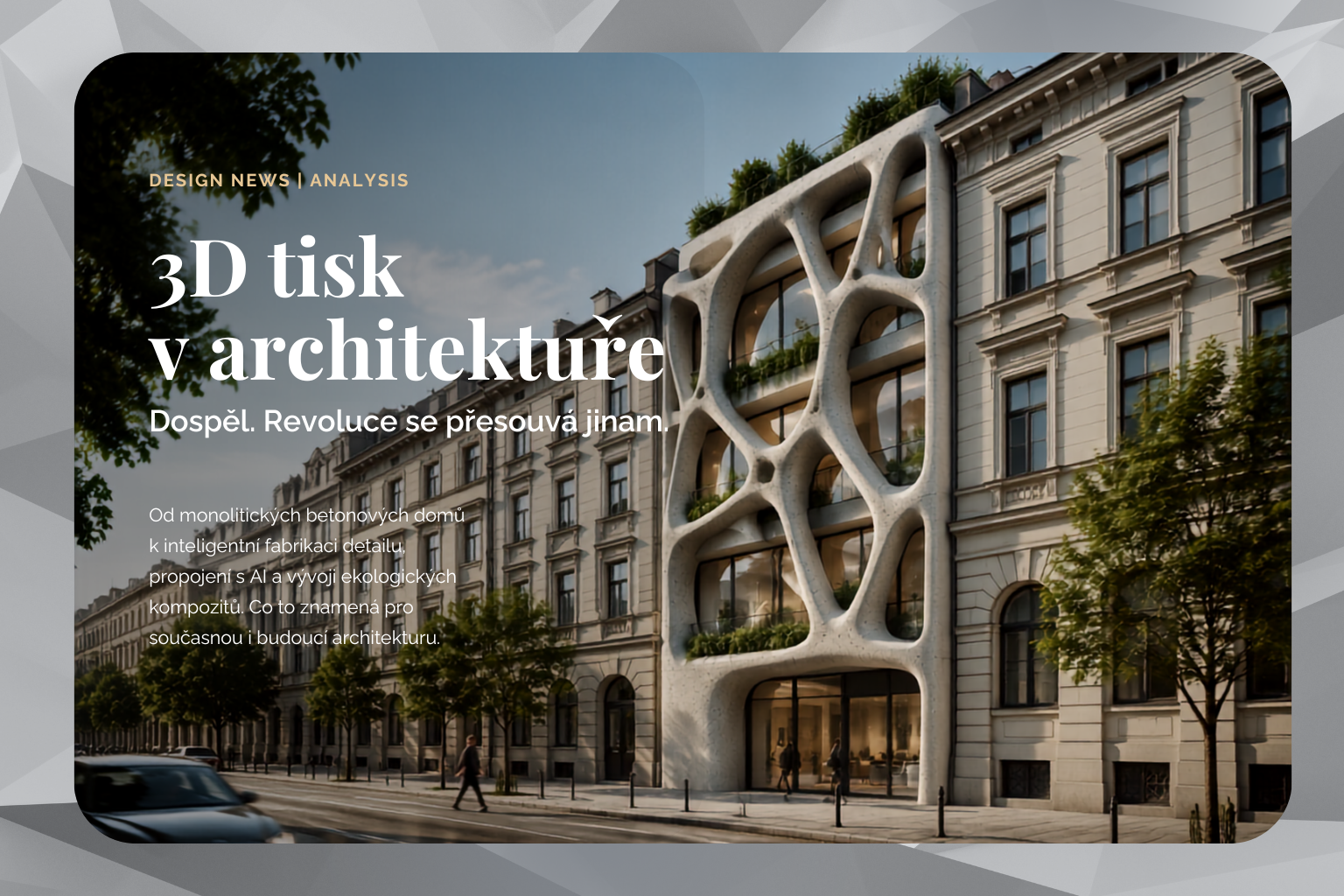
At Grain of Design, we follow technology primarily from the perspective of its real contribution to architecture and interior design.
Instead of short-term trends, we look for changes that can influence the way we design and live in the coming years.
Fascination with monolithic concrete houses printed to order is gradually fading. The real architectural transformation today takes place in the intelligent fabrication of building details, generative design, and the development of ecological composites.
When people hear 3D printing in construction, most still picture a large gantry printer building up a rough family home layer by layer. Years of marketing have successfully planted this image in our collective imagination.
In practice, however, things have moved on.
The monolithic printed house revealed the limits of current technology. Architects and research teams have therefore shifted their attention from entire buildings to individual building components — the area where additive manufacturing delivers far greater technical, economic, and architectural value.
The 3D-printing revolution has not disappeared.
It has simply grown up.
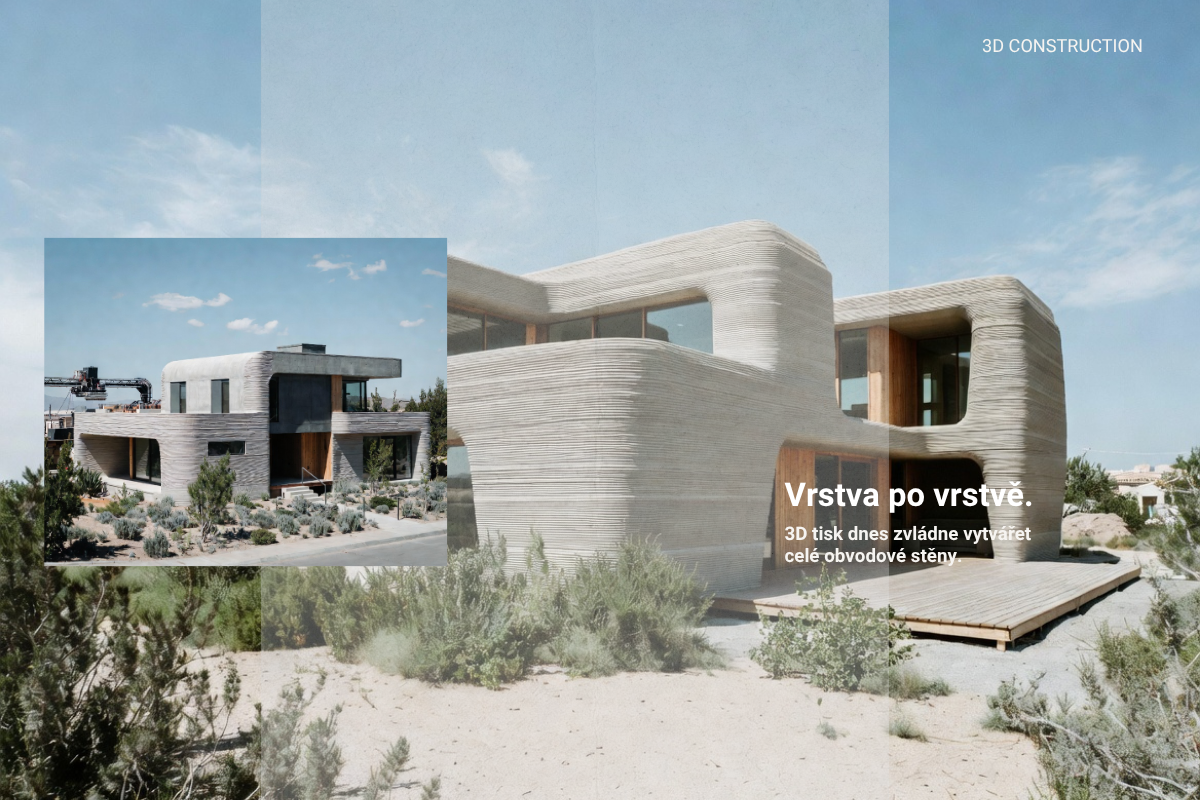
ᴳᴰ Visualisation created using generative AI · Concept and creative direction: Grain of Design
1. From the Whole to the Detail: Micro-architecture and Fragmentation
The most fundamental shift is one of scale.
Rather than attempting to print an entire building at once, 3D printing is becoming a precision tool for producing highly specialised building components.
The future will likely not be shaped by a single printed house, but by a house assembled from thousands of precisely designed and optimised details.
Today, additive manufacturing is most commonly applied to:
- facade panels with integrated thermal insulation, water drainage, or controlled airflow,
- acoustic panels with geometry optimised for specific frequencies,
- structural nodes for steel and timber buildings,
- lost formwork and moulds for casting complex concrete elements.
This is not simply about making different parts.
Each element can respond to its precise location within the building — orientation to cardinal directions, solar radiation intensity, acoustic conditions, or airflow patterns.
The future may not lie in 3D-printed houses, but in houses assembled from thousands of cleverly designed and digitally manufactured details.
2. Mass Personalisation: The End of the Standardised Form
Traditional production of building elements rests on the economics of repetition.
Manufacturing moulds carries high upfront costs, making it cost-effective only for large production runs.
3D printing changes this logic entirely.
Because it works directly from a digital model, every piece produced can be different — without the need to manufacture new moulds or reconfigure a production line.
This opens an entirely new way of designing. An architect can conceive a facade where every panel is unique — each responding to a different amount of solar radiation, different acoustic requirements, or a different orientation to its surroundings.
Traditional Production
- high mould costs
- economics based on repetition
- standardised elements
- limited variability
3D Printing
- no production moulds needed
- every piece can be an original
- geometry tailored to the specific location
- greater authorial design freedom
3. AI and 3D Printing: A New Design Partner
The combination of artificial intelligence and additive manufacturing represents one of the most significant shifts in contemporary architecture.
Previously, the design process was largely linear.
Today, a digital design loop is emerging.
Artificial intelligence does not replace the architect. It can, however, analyse hundreds of structural variants in a matter of minutes, searching for the optimal balance between strength, weight, material consumption, and production costs.
The result is organic structures that resemble natural skeletal systems or cellular tissue — geometries that would be extremely difficult, or even impossible, to produce using traditional manufacturing methods.
This is precisely where 3D printing becomes irreplaceable.
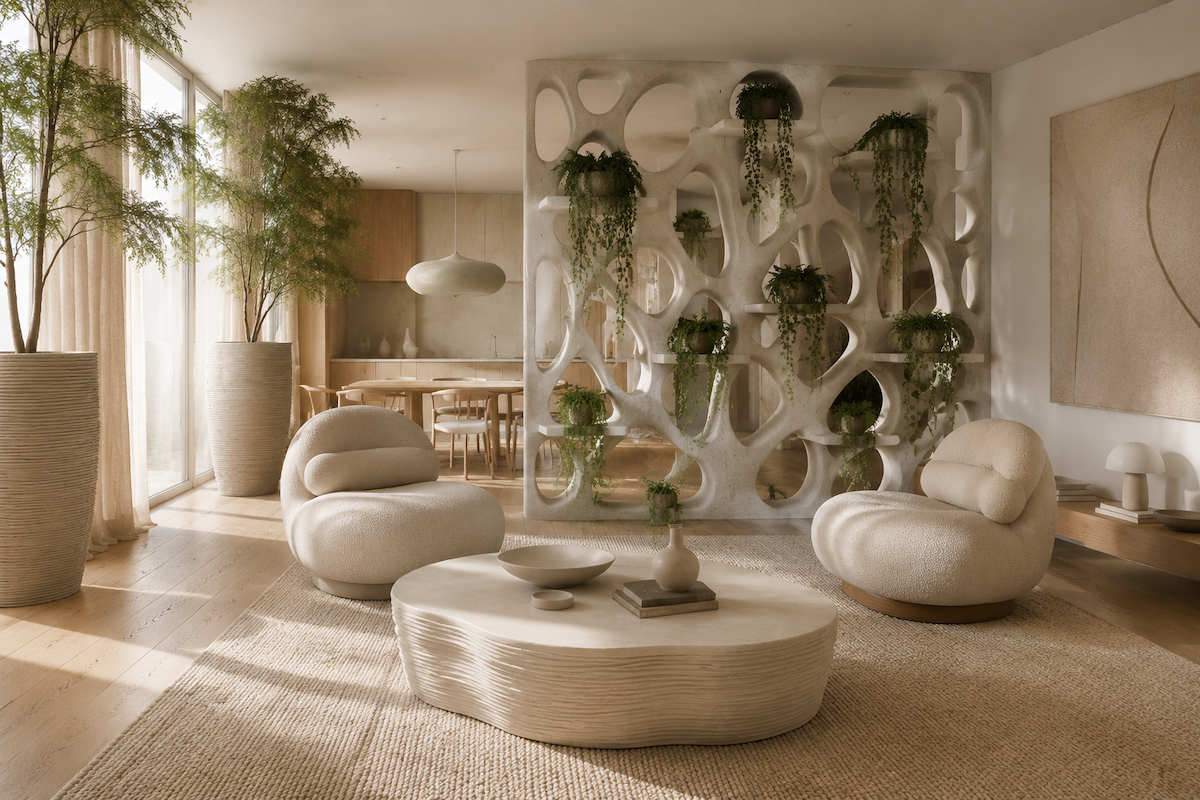
ᴳᴰ Visualisation created using generative AI · Concept and creative direction: Grain of Design
4. From Printer to Robotic Manufacturing Cells
The image of the standalone 3D printer is gradually fading. Contemporary production is shifting towards fully integrated robotic workstations.
Within a single production cycle, a robot can:
- print material,
- machine the surface,
- drill anchor holes,
- laser-scan the geometry,
- continuously monitor quality using sensors and AI.
Manufacturing is thus evolving from a single technology into a complex digital production process.
5. Sustainable Renaissance: Advanced Biomaterials
The first generation of construction 3D printing was associated primarily with concrete and synthetic polymers. Current research is increasingly oriented towards materials with a lower carbon footprint.
Materials gaining significance include:
- unfired clay,
- clay composites,
- wood fibres,
- biocomposites,
- geopolymer mixes,
- recycled construction rubble,
- materials incorporating hemp shive,
- experimental composites using mycelium or seaweed.
Architecture is thus returning, in part, to its natural roots.
This time, however, with the precision of digital manufacturing.
6. Reality Without Marketing: What Can't 3D Printing Do Yet?
Despite rapid development, there are numerous areas where traditional construction technologies continue to play an irreplaceable role.
The main limitations include:
- installation of mechanical, electrical, and plumbing systems,
- integration of steel reinforcement,
- finishing construction work,
- certification and legislation,
- the economics of high-rise buildings.
Marketing often creates the impression that the future belongs to entirely printed cities. The reality, for now, is far more measured.
And precisely for that reason, far more interesting.
Conclusion: The Future Lies in Quiet Integration
Perhaps we imagined the future of 3D printing too simply.
Not as thousands of small innovations.
But as a single great upheaval.
Reality is far more interesting.
The future of architecture will probably not emerge through houses printed in a single day. It will emerge through thousands of precisely designed details — lighter, smarter, more sustainable, and perfectly adapted to their specific location.
3D printing is no longer a novelty.
It is becoming a natural part of architectural design.
And that is precisely when a technology truly comes of age.
How do you feel about it?
Would you like to live in a house where every detail was calculated by AI and printed by a robot — or do you still need to sense the trace of a human hand in architecture?
Write to us via the Grain of Design contact form.